The Chairman of Everything.
In October 2025, Nasser Al-Khelaifi took a seat on the FIFA Council as the elected representative of European football's clubs. It closed a set of positions inside the sport's own governing bodies that had been building for six years — none of it equity, all of it influence. The consequential story is how an appointed administrator turned a management brief into control of the institutions that govern the sport he was asked to run.
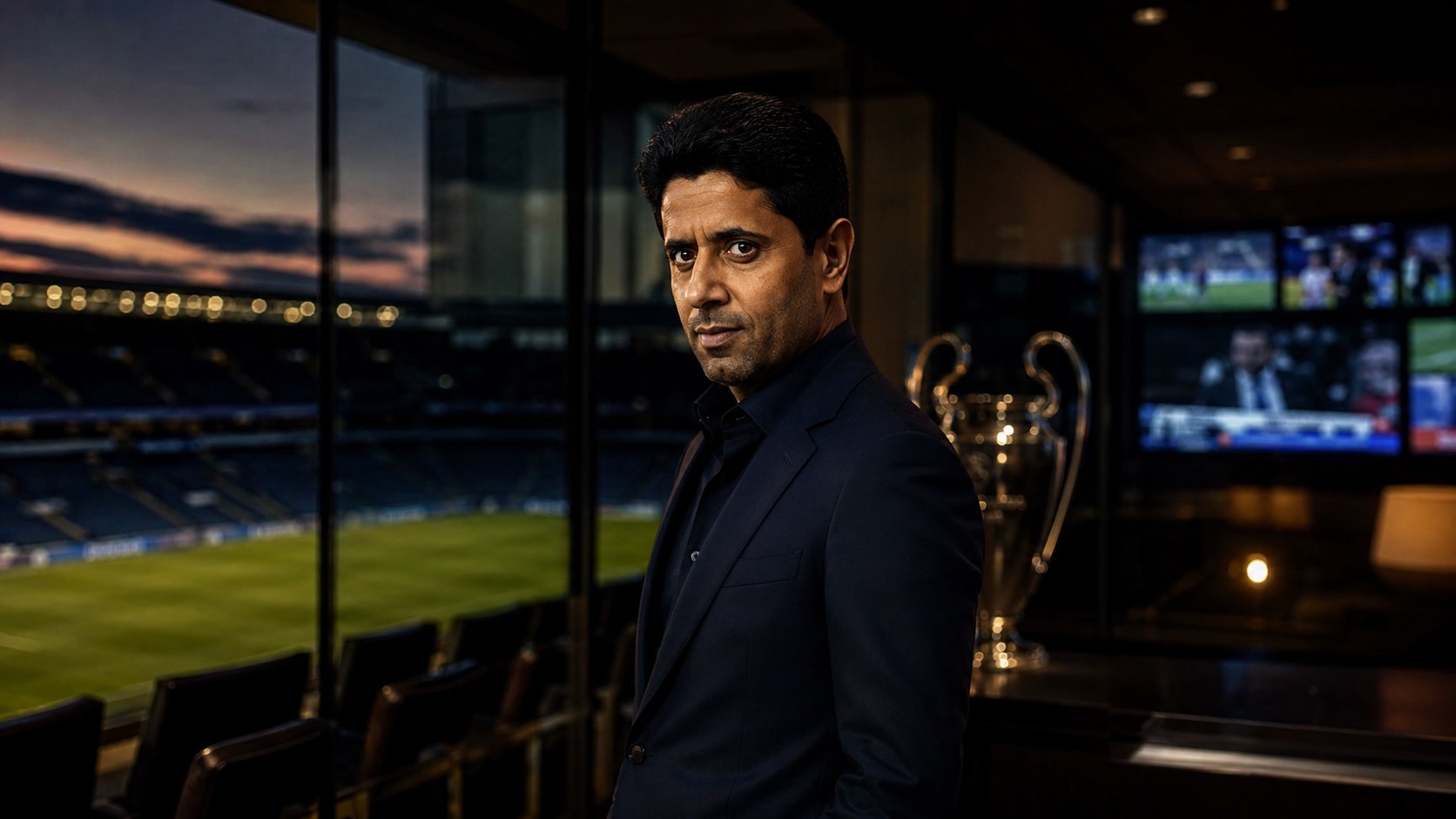
No other individual currently holds a position inside all three of these bodies — UEFA's Executive Committee, ECA (now European Football Clubs), and the FIFA Council — while simultaneously running one of the world's leading clubs and a broadcaster that reaches more than forty countries. Paris Saint-Germain, Qatar Sports Investments and beIN Media Group are all owned by the Qatari state, not by Al-Khelaifi personally. His route to influence runs through chairmanships, not equity.
01 Foundation and pivot
Al-Khelaifi's route into football did not run through a boardroom or an investment fund. He was a professional tennis player, turning pro in 1993 and retiring in 2004. The tennis itself explains little. What matters is the period it covers: those were the years in which, by multiple accounts, he built a personal relationship with Sheikh Tamim bin Hamad Al Thani, now the Emir of Qatar. That relationship is what put him in a position to run the country's sports and media assets once Qatar decided to build them.
Qatar Sports Investments was formed in 2004, and Al-Khelaifi became its chairman when it acquired Paris Saint-Germain in 2011 for a price widely reported at approximately €70m, though no single primary disclosure confirms the exact figure. Three years later, in 2014, he was appointed group chairman of a newly created entity called beIN Media Group, built out of the existing Al Jazeera Sport operation. From 2014 onward, Al-Khelaifi was running a football club and a global broadcaster at the same time, both owned by the same state, both reporting to him.
The commercial ambition was declared almost immediately. In July 2012, one year after taking control, QSI signed Zlatan Ibrahimovic and Thiago Silva from AC Milan for a combined transfer fee of around €65m. Ibrahimovic in particular signalled that Paris was now to be treated as a top-table European destination. A mid-tier Ligue 1 club six months earlier was suddenly a market Milan itself was selling its captain to.
02 The empire today
Figure 1 sets out the current structure. It is not an ownership chart in the way a personal business empire would be, because nothing in it belongs to Al-Khelaifi individually: every entity is owned by the Qatari state, and he holds a board seat, a chairmanship, or both. Two details worth surfacing beyond what the diagram shows. At Eupen, QSI assumed operational control of the club's sporting activities immediately on signing the December 2025 memorandum of understanding, even though the full legal acquisition remains subject to regulatory approval and has not been confirmed as closed. At Miramax, beIN's original acquisition was diluted in 2020 when Paramount Global bought a 49 percent stake, leaving beIN's holding at 51 percent rather than full ownership.
Figure 2 separates the ownership stack from something structurally different: the seats Al-Khelaifi has personally won through election inside football's own governing bodies. Being appointed to run a state-owned club is one thing. Being elected chairman of an association representing more than 800 clubs, or winning a seat on UEFA's Executive Committee as its first Asian member, is another, and depends on political skill rather than a state mandate.
03 The machine behind him
Day-to-day operations at beIN sit with chief executive Yousef Al-Obaidly, who reports to Al-Khelaifi's chairmanship rather than replacing it. Above the operating companies sits the Qatar Investment Authority, the sovereign wealth fund on whose board Al-Khelaifi also sits, and above that, the Qatari state itself, where he additionally holds the title of Minister of State. His authority runs through chairmanships rather than equity, extended further by a board seat at France's Ligue de Football Professionnel and, since December 2024, the chairmanship of the EFC Foundation, the charitable arm of the body he leads.
04 The flagship
The single achievement that best defines Al-Khelaifi's career is an institutional turnaround rather than a transaction. He took over the chairmanship of the European Club Association in 2021, shortly after the body's standing had been damaged by the failed European Super League project. Under his chairmanship, the organisation rebranded in October 2025 as European Football Clubs, now representing more than 800 member clubs, and used its 2023 memorandum of understanding with FIFA to raise the FIFA Club Benefits Programme, which compensates clubs for releasing players for the World Cup, to $355m for the 2026 tournament, a nearly 70 percent increase on the $209m paid out after the 2022 World Cup.
Figure 3 places that governance dividend alongside PSG's own revenue growth under his presidency. The club has itself disclosed that turnover rose from €99m in 2011, the year of QSI's acquisition, to a record €837m in the 2024-25 season, a reported ninefold increase. The two figures measure different things — one a club's own disclosed revenue, the other a negotiated per-tournament payment pool — but together they describe the same underlying pattern: an operator whose influence compounds both through the assets he runs and the rules he has helped rewrite.
PSG's on-pitch results have tracked the same curve. The club won its first-ever UEFA Champions League title in May 2025 and retained it in May 2026, becoming the first club to win the trophy in consecutive seasons since Real Madrid's three-in-a-row between 2016 and 2018. The commercial engine sitting beneath those results extends well beyond Europe. The 2018 partnership with Nike's Jordan Brand — the first of its kind between the sportswear label and a football club — has become one of the club's most consequential commercial moves; Al-Khelaifi has publicly called it “one of the best decisions we have made in Paris,” crediting it with opening new global markets and audiences, particularly in the United States.
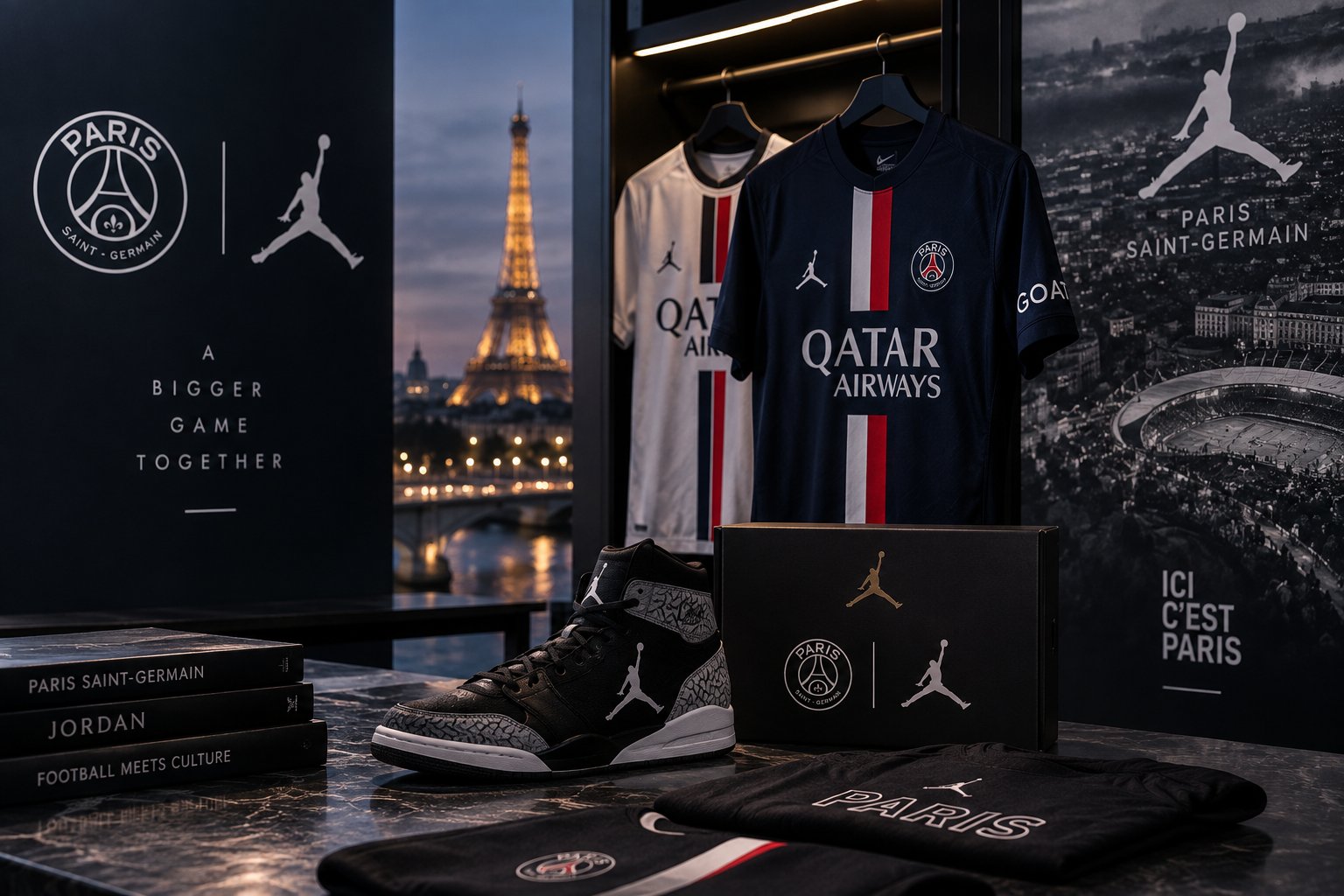
Forbes valued the club at $4.6bn in 2025, up from $4.2bn in 2023. A club acquired for a price reported at roughly €70m in 2011 does not reach that valuation or two consecutive European titles through ownership alone. It requires the kind of institutional access that a chairman with seats on UEFA's Executive Committee and inside FIFA's own governance can bring to scheduling, competition structure and commercial negotiation — and, alongside it, commercial partnerships that reach audiences the sport had not previously monetised at scale.
05 Where it goes from here
Two developments will shape the next phase. First, the addition of Braga and Eupen points toward a genuine multi-club strategy, with PSG positioned as the flagship of a wider network rather than a standalone asset. Second, in late July and early August 2026, British media reported that senior UEFA figures had discussed encouraging Al-Khelaifi to stand as a candidate for the FIFA presidency in the March 2027 election. His office ruled this out in mid-August, and he confirmed the decision himself after PSG's UEFA Super Cup win, saying he intends to remain at the club. Whether or not he ever runs, the fact that his name was raised at all is a measure of how far his standing inside the sport's governing institutions has travelled from a management appointment made in 2011.
The pattern Al-Khelaifi's career describes — building durable influence inside the sport's own regulators rather than relying on ownership of a single club alone — is one other state-linked and sovereign-backed owners now have a working example of. What he has built compounds differently from a personal fortune: a set of votes and chairmanships that outlast any single asset's valuation cycle.