On is running the Jordan play. At full price.
A challenger running brand has bet on one athlete to open football the way Nike once bet on Michael Jordan to open basketball. On has run a version of this play before, with Roger Federer. The two deals share a structure. They do not share a risk.
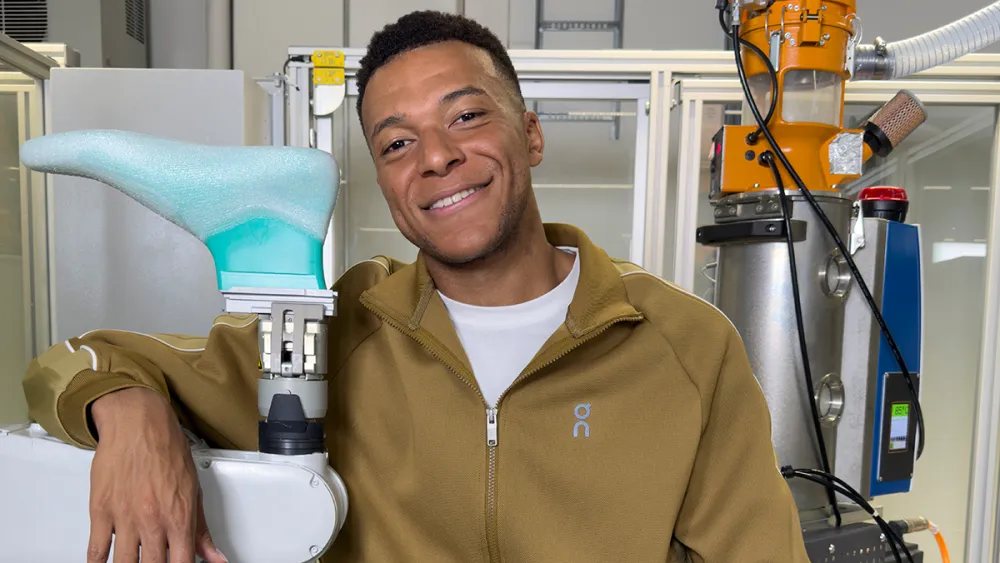
On announced on Friday 18 September that Kylian Mbappé is joining as a global ambassador, ending a Nike relationship that began when he signed as a child in 2006 — roughly two decades. Nike, according to CNBC, chose not to renew after his contract expired on 31 July, twelve days after the World Cup final. The agreement, which makes Mbappé the face of On's entry into football, includes both cash and equity, though the value has not been disclosed. The company named Thierry Henry its director of football the same day. Three days later, Nike was removed from the S&P 100, ending a run of nearly two decades. The week's story looked like a transfer. It reads better as a trade — and to price a trade, start with the buyer.
01 Why football, why now
On was not a company that needed a rescue signing. Net sales grew 30 per cent in 2025 to CHF 3.01bn, and guidance points to at least 23 per cent further growth in 2026 on a constant-currency basis — CHF 3.44bn or more. Gross margin reached a record 65.4 per cent in the most recent quarter. Founded in 2010 and public on the NYSE since 2021, On has been taking share directly from Nike and Adidas in the United States and, more recently, China. There is one crack in the run: that same quarterly report missed on sales, and the stock fell by roughly a fifth in a day. Remember that detail.
Football is the one major global sport On had not entered, and this is not the first time it has run the play. Roger Federer left Nike for Uniqlo in 2018, then took a stake of roughly 2.5 per cent in On itself in 2019, becoming an ambassador-owner and design partner rather than a conventional endorser. The cash-plus-equity structure behind Mbappé's deal already existed inside the company; football is simply the newest sport for an existing playbook.
The market he enters is a duopoly. At this summer's World Cup, Nike boots were worn by 42.8 per cent of players and Adidas by 39.7 per cent — more than four in five players between them — with Puma at 10 per cent, according to a count by the specialist platform Footpack. Brands that tried entering gradually, building rosters of mid-tier names, never moved that market; Under Armour and New Balance are the clearest examples. One transcendent signing is a faster route in. That is the buyer's logic. The other half of the trade is why the biggest athletes keep agreeing to leave.
02 A pattern bigger than football
Mbappé's move is one instance of a broader renegotiation. The standard model — a fixed endorsement, with the legacy brand keeping all the equity — is being rewritten by the athletes who matter most to it. In football alone, the recent record reads as a procession:
- Lamine Yamal left Nike for Adidas in February 2024, after a reported bidding war.
- Ousmane Dembélé switched to Adidas in 2023 — and won the 2025 Ballon d'Or wearing it.
- Rodrygo ended a ten-year Nike relationship for Adidas, announced in December 2025.
- Harry Kane signed a lifetime deal with Skechers in August 2023.
- Neymar left Nike for Puma in 2020.
The clearest parallel to Mbappé sits outside football. Stephen Curry was a Nike athlete through his first four NBA seasons before Nike, in an infamous 2013 pitch meeting, mispronounced his name and presented from a recycled slide bearing Kevin Durant's. Under Armour, then a minor challenger in basketball, signed him instead. That bet built a signature business reportedly worth around $100m a year — and in November 2025 Curry left Under Armour too, with the company saying he would take ownership of the Curry Brand name and logo. The pattern has history: Nike lost the teenage Messi to Adidas in 2006, reportedly over a few hundred dollars of tracksuits it would not supply. What is new is what the athletes leave for — equity, ownership, or labels of their own, from Tiger Woods's Sun Day Red to Simone Biles's 2021 move to Athleta.
Nike's position adds context rather than crisis. It retains Erling Haaland and Vinícius Júnior, and one departure decides nothing. But the tape is hard to argue with: the stock has fallen roughly 80 per cent from its November 2021 peak near $178 to about $36 the day Mbappé signed, and its removal from the S&P 100 followed within a week — pressure chief executive Elliott Hill is expected to reverse. Rivals are watching the same thing the market is: whether a credible third bidder offering cash and equity changes what every free agent asks for next. What looks like one signing is the visible edge of a repricing.
03 The contrarian read
The week's coverage told a simple story: a hungry challenger stole the world's most famous footballer from a wounded giant, and the Michael Jordan comparison did the rounds within hours. The comparison is right about the shape of the deal and wrong about the price of it. Jordan was a rookie who started his career, signed for $2.5m over five years, because Nike could not afford established stars. Mbappé is the established star, and even undisclosed, his package is clearly on another scale. Jordan came cheap because nobody yet knew what he would become. Mbappé costs full price because everybody already does. This deal does not create On's position in the market — it cements one the company already holds.
The model's favourite proof is Federer. Look closer, and he proves the risk, not the reward. Forbes declared him a billionaire in August 2025 on the strength of his On stake. Twelve months later it took the title back: weak quarterly results cut the shares by a fifth, and On's market value on the day Mbappé signed was about $9.1bn, roughly half its early-2025 peak. That is the deal Mbappé has just accepted: part of his pay is shares that lost a third of their value in the past year. Equity is what makes the new athlete model richer than any endorsement. It is also the only part of it that can go down.
So the signing is not the bet; the build is. The recent exits show the full range of what happens next. Federer's stake made and then unmade a billionaire. Woods's Sun Day Red has been described by one industry analyst as not having "done much." Curry's brand, even with ownership secured, brings in roughly 2 per cent of Under Armour's revenue; Jordan Brand is 16 per cent of Nike's, on Sportico's figures. The difference between a Jordan and a Sun Day Red was never the athlete's fame on signing day — it is what the company builds in the five years after. On has so far built one prototype boot, made with its LightSpray technology, with retail not expected until 2027.
What On builds around Mbappé will decide what the deal was: an entry into football — measured by a boot roster within two years — or a demonstration that a $9bn challenger can buy the front row of any sport it chooses, with basketball and tennis holding marquee free agents of their own. And the harder question belongs to Nike: having lost the World Cup's biggest name the same week it left the S&P 100, does it start paying to defend the athletes who define its categories — or keep treating each departure as discipline?