How Florentino Pérez's fiscally driven approach to running a football club has laid the blueprint for others to follow.
Florentino Pérez, over 26 years ago, won his first election to become Real Madrid President when the club was over €250 million in debt. Today, Real Madrid generate over €1.2 billion in annual revenue and are the most dominant club in Europe winning 6 of the last 13 Champions Leagues. So how does Florentino Pérez's reign as the president of his boyhood club encapsulate the importance of branding and the commercial modernisation of football clubs? Let's find out…
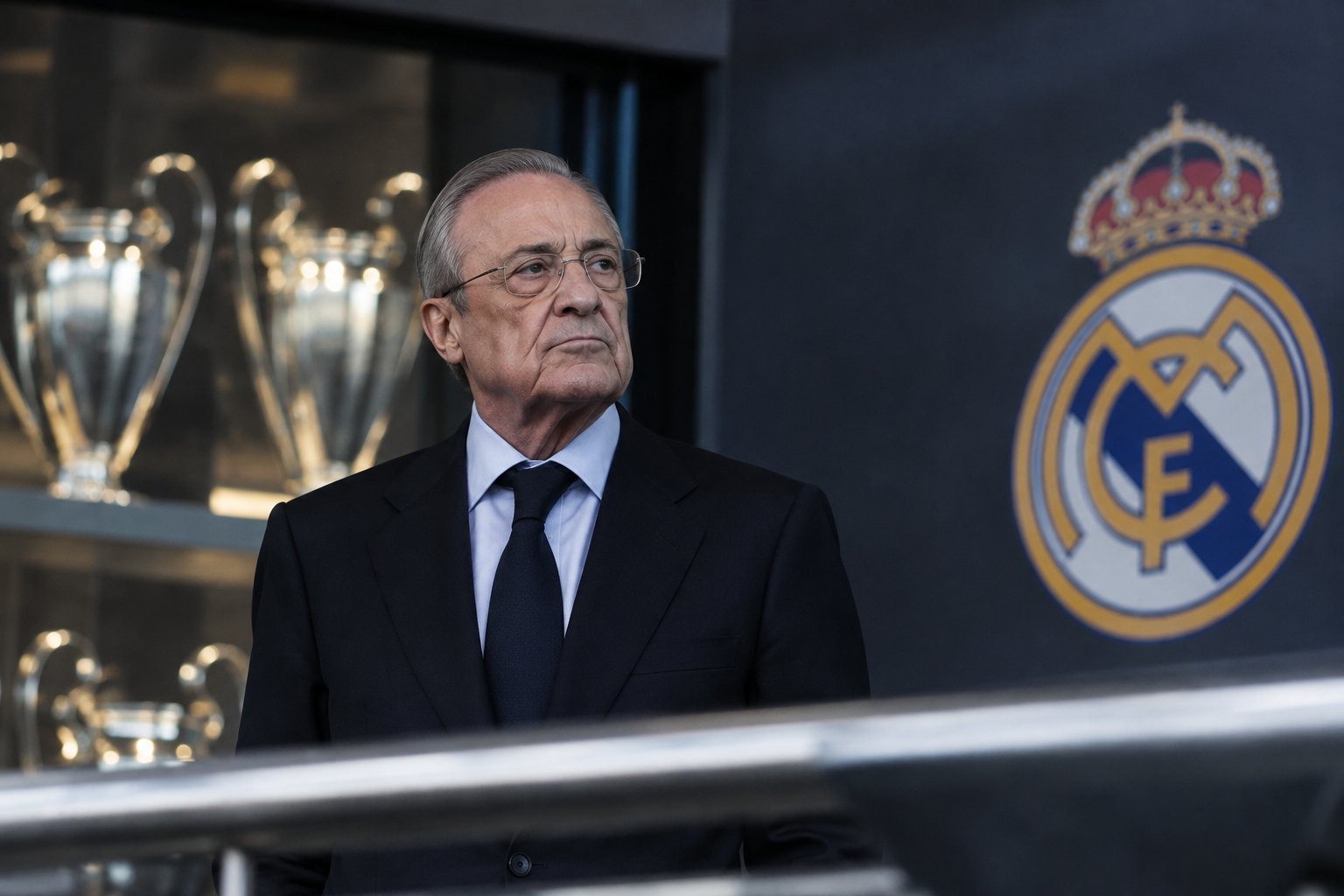
01 Becoming President and the Changing of Fortunes
Interestingly; only two months prior to Florentino Pérez's successful presidential campaign in July of 2000, Real Madrid had been crowned European champions. So why were the fans of a club who just reached the pinnacle of European football for a record setting eighth time so eager to see a shift in power? If on-pitch success had anything to do with this presidential election Pérez almost certainly would've found himself finishing as runner-up. Naturally, Pérez's campaign actually had very little to do with football. Pérez himself even admitted; "I know nothing about football". He believed that his background in business and politics would ultimately be the differentiator come election time. He was right.
He constructed a narrative, like any good politician, that his previous experiences in business (most notably as Chairman and President of ACS Group, Spain's largest construction company worth over US$2.5 billion) and politics (member of Madrid's city council) were far more important than any level of football expertise could be. He then promised to eliminate the debt of more than €250 million which was an evergrowing shadow held over the head of previous president Lorenzo Sanz. Furthermore, he planned to completely restructure the sporting, marketing, and social strategies of the club.
Giving Real Madrid's supporters the gift of hope through these enticing narratives and promises is one thing, but executing them is what continues to set Pérez apart from his counterparts.
Pérez's canonic moment, away from the pitch, where he could flex his business acumen and political pull was through the sale of Real Madrid's old training facility. The "Ciudad Deportiva" was built on the outskirts of the city in the 60's but had found itself in the midst of Madrid's rapidly expanding financial district some thirty years after its construction. The land had become extremely valuable and Florentino Pérez was not the first to come up with the idea of selling the property in order to pay off the club's debt. But, he was the first one able to execute the idea. To make a long story short; the club had never been able to sell the land due to strict non-commercial zoning laws enforced by Madrid's City Council. Pérez pulled the strings of a few old colleagues within Madrid's City Council and ended up striking a deal where he would give the city of Madrid a portion of the land as part of the rezoning deal. Real Madrid ended up selling their portion for approximately €500 million. Pérez had immediately paid off the debt, and then went on to build a brand new state of the art training facility (Ciudad Real Madrid), and then put the remaining profit of €100 million or so back into the club.
Pérez had now established a principle that would underpin the rest of his presidency; to treat Real Madrid's assets as potential sources of capital across multiple markets.
02 The Galácticos Era; Turning Players into Commercial Assets
If the sale of the Ciudad Deportiva demonstrated how Pérez viewed Real Madrid's assets as multi-dimensional sources of capital, his first transfer window demonstrated how he intended to treat his players the same way. Infamously, Pérez's first signing was Luis Figo. At the time Figo was the captain of arch rivals Barcelona and was widely regarded as the best player in the world. The transfer was made possible through an agreement involving Figo's representatives and Pérez's campaign before the election, with severe financial penalties attached if the arrangement was not honoured. As Pérez won the election, Real Madrid activated Figo's release clause of 10 billion pesetas (€60 million), making him the most expensive player in football history at the time. The consequences of that transfer extended far beyond the football pitch. Figo's agreement with Real Madrid also gave the club a significant share of his image rights. This was central to Pérez's thinking: before the transfer was completed, Real Madrid had already identified commercial opportunities connected to Figo's image, and the club established a structure specifically to manage those opportunities.
This gave way to the creation of the "Galácticos" era and business model. Pérez was not necessarily searching exclusively for the best footballer available in every position. He was searching for players whose value existed beyond the pitch and spanned across numerous markets, he wanted the biggest names. A signing like Zinedine Zidane brought perhaps the greatest footballing prestige of his generation. The signing of Ronaldo brought enormous global recognition, particularly in South America. David Beckham was the final straw. He arrived with a commercial profile that already extended well beyond the sport itself. The player, in Pérez's Galáctico model, was no longer only an employee whose value could be measured through goals, assists, and trophies. They were also vehicles through which Real Madrid could sell products (jerseys and seats on matchday), attract new sponsors, access new broadcasting markets, and subsequently increase the value of its own brand around the world.
The impact on merchandising revenue was immediate. Real Madrid reported that official-store sales rose by 35% during the 2000/01 season, Pérez's first season at the helm. When Beckham was presented as a Real Madrid player in 2003, the club sold 8,000 shirts on the day of his presentation alone. Naturally these major signings created sporting value, but it also created a commercial event. This was particularly important as football's commercial centre of gravity became increasingly global. Real Madrid's official products are sold in more than 100 countries, with international sales accounting for approximately 75% of the Adidas-Real Madrid textile business. The increase in broadcasting coverage in Asia, Africa, and the United States are key markets in which the Galácticos era inspired Real Madrid's commercial growth. The Galácticos did not create Real Madrid's international support from nothing, but they gave the club a powerful commercial platform which they continue to capitalize on today.
Pérez also sought to gather capital from his Galácticos beyond the shirt sales themselves. Real Madrid's contracts with major signings increasingly included new commercial image-rights agreements. Reports suggest that Beckham's arrival at the club prompted Real Madrid to earn 50% of personal sponsorship contracts entered into during his time at Real Madrid, while the same basic principle had already been used in the signings of Figo, Zidane, and Ronaldo. Some of today's superstars like Mbappe have pushed back and fought to own upwards of 70% of their image rights.
Regardless, Pérez had masterminded a positive feedback loop of sorts where the global image/brand of both the club and its players will grow simultaneously. A similar mutualistic relationship exists between Real Madrid and its shirt sponsors. In 2002, Siemens Mobile agreed to pay €12 million per season to become the club's shirt sponsor. More than a decade later, Emirates' first main-shirt agreement was reported at €25 million annually, potentially rising toward €30 million through incentives, before a later renewal was reported at €70 million per year. The rise in shirt sponsorship prices are not figures that can be attributed to the Galácticos alone, but they illustrate the influence of the "Galácticos model" and the direction in which Pérez's commercialization took the club. As Real Madrid's global audience compounded year on year, access to its shirt, its players, and any other facet of the club became increasingly valuable. The Galácticos, therefore, were never simply a collection of expensive footballers. They were the first large-scale expression of Pérez's broader economic philosophy surrounding the club.
03 Modernisation of the Football Club
If the Galácticos could become commercial assets, why couldn't 'Real Madrid' itself become a sought after brand? This is arguably Pérez's most impactful contribution to the club. The focus was no longer for the club to be seen as winners on the pitch but Pérez wanted the club to "win" off the pitch. He did this by turning the club's name itself into something people wanted to associate with, wear, visit, and support regardless of whether a match was taking place. This approach resulted in Real Madrid's reported €1.221 billion in operating revenue from the 2025/26 financial year, making them the first sports enterprise to ever create over €1.2 billion in annual revenue. While Deloitte's Football Money League, an annual ranking of football's top earning clubs, placed the club first in world football for a third year in a row and an eleventh time in the last 16 years. Deloitte also reported that of the clubs revenue in 2026, €594 million was in commercial revenue alone which in and of itself would've placed the club in the top 10 revenue generating clubs around the world last year.
A look at the Club's operating-income graphic shows a business that has fundamentally changed since Pérez arrived. In 1999/00, the season immediately before his first election, Real Madrid generated €118 million in operating income. By 2025/26, that figure had reached €1.221 billion—more than ten times the level at which Pérez inherited the club. In its 2010/11 Annual Report, Real Madrid stated that its future projections were based on "strengthening the brand" through the investment and commercialisation of big name players, the development of new business lines, and international expansion. Stadium, broadcasting, and marketing revenues have all skyrocketed as Real Madrid have deliberately diversified the ways in which its name can generate money. The modernisation of the Bernabéu is perhaps the clearest physical manifestation of this diversification. The stadium's renovations required monumental investments, of both time and money, but it will now serve as the bedrock for the club's future revenue. Adopting the 365 day stadium model means that it doesn't only serve as a venue in which Real Madrid plays, but it will serve the city as an entertainment hub capable of attracting different sources of revenue throughout the year. Concerts, annual NFL games, Tennis tournaments, stadium tours, social events, restaurants, and never before seen premium seating (VIP) packages have all become part of the stadium's business model to generate revenue outside of the few dozen home matchdays per year.
The numbers suggest that the introduction of these new revenue sources have produced an immediate return on investment. In 2025/26, stadium revenue increased by 11% from the previous year. This includes revenue from the "personal seat license" (VIP) product alone. The personal seat licence model is particularly revealing because it allows Real Madrid to monetise access to the Bernabéu beyond the traditional purchase of a match ticket. The customer is paying for VIP access to the club's hospitality environment which has become a commercial product in its own right. It's almost like paying for a country club membership. When the prices of these VIP memberships cost over €200,000 the club is fostering an environment where society's elite can brush shoulders with one another, and as a result of this environment the club are tapping into a social status element which is further increasing the brand's image among the elite as well as further integrating itself within the infrastructure of a highly affluent European city like Madrid.
This is certainly Pérez's greatest achievement, the concept of Real Madrid's superiority across European Football has now been translated into its brand. Its societal status stands for excellence. Now the onus is on other companies to unite with the club; who wouldn't want to be mentioned in the same breath as Real Madrid? Wisely, he didn't commercialise Real Madrid at the expense of its identity; he commercialised the identity itself.
04 The European Super League…sigh
The European Super League was presented in 2021 as a new elite competition bringing Europe's biggest clubs together in a largely closed league, modelled in part on the structure of American sports where there are no relegation or promotion systems in place. It was completely and utterly rejected by football fans from around the world and it lasted approximately 48 hours before the backlash forced the English clubs to withdraw, resulting in the original proposal's collapse.
But why is Florentino Pérez still in favour of the proposed European Super League?
Perhaps the answer lies in everything we have discussed so far. Pérez has spent the last 26 years modernising his club inside and out, turning Real Madrid into a commercial machine. So why would he be in favour of an old footballing system where a single poor season, let alone a few poor results, could take away hundreds of millions in expected revenue? The Super League offered something European football traditionally does not: greater financial predictability. Its closed structure resembled the Franchise League Model we see in American sports. Pérez himself argued that the existing system was financially unsustainable, claiming that the Champions League generated insufficient revenue and that the Super League was necessary to "save football." Unsurprisingly, supporters saw this very differently. The Super League became a spectacular reminder that football is not simply an entertainment product to be optimised like an American sports franchise. Yet Pérez has clearly not abandoned the idea and often still states that he is in favour of pursuing it further.
Pérez might not want to tarnish his legacy by dying on the Super League hill. For a businessman at heart, the economic systems check out. And interestingly, we may have already begun seeing a softer version of the system he feared losing out on? The English Premier League generated £6.8 billion in 2024/25, while its traditional "Big Six" accounted for 73% of the league's commercial revenue. Perhaps Pérez believes his fantastical ESL will be saving European football from the monster which has already blindsided the rest of the continent, the English Premier League.
05 Forward looking
Pérez is now 79. Every asset he inherited has been converted into capital — the land, the players, the stadium, the name. Whatever he does next, it will almost certainly follow the same principle.
What could be Florentino's next big bet? Another run at the Super League, a media business the club owns outright — or the one asset no Real Madrid president has ever touched: the club's own ownership?