Small-sided football has the money. Which format survives to 2028?
Investors are pouring record money into small-sided football — and yet one well-funded league has just shut down in the country where it launched. The format has clearly arrived. The real questions are whether it threatens traditional football, and which version of it survives.
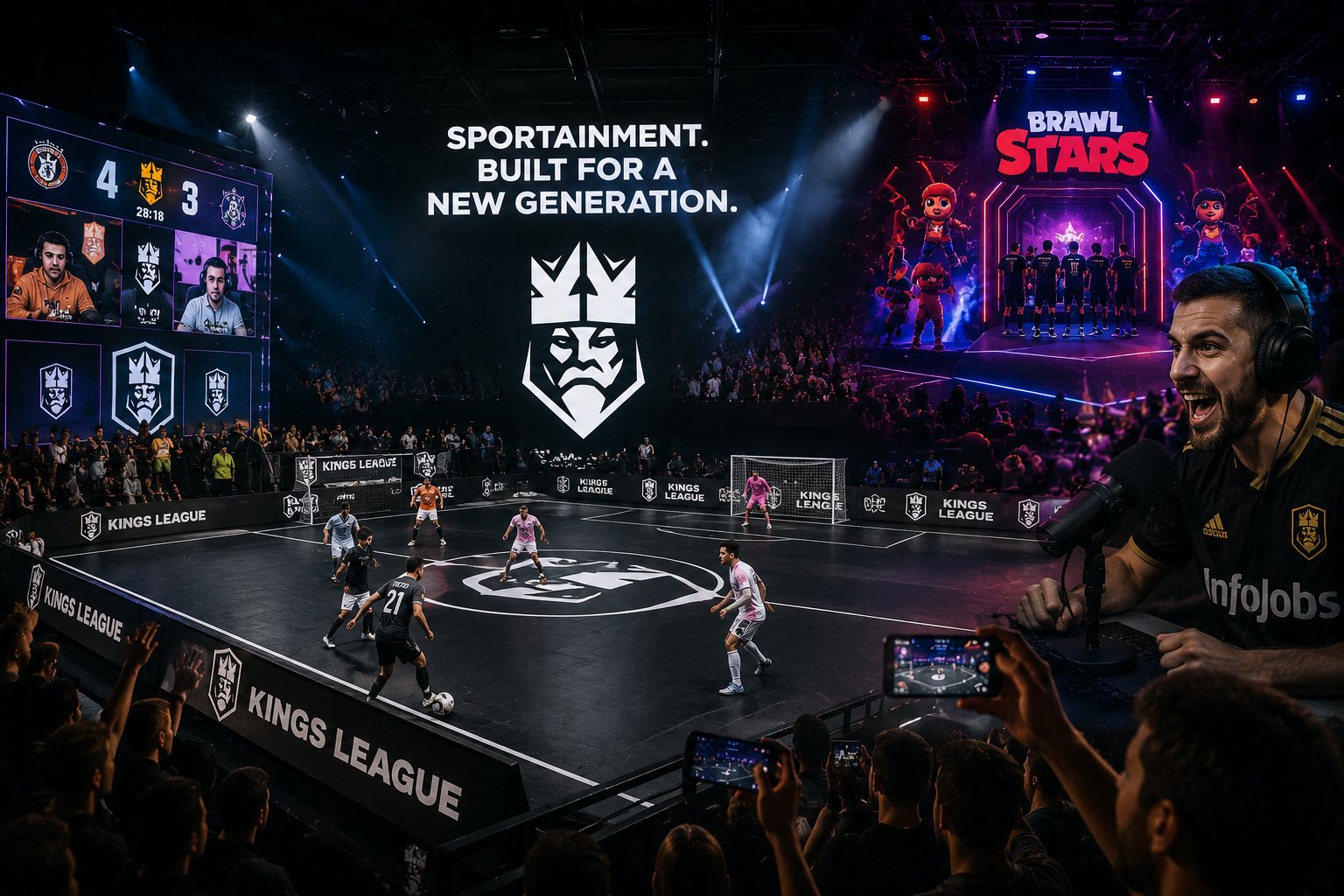
In January 2023, Gerard Piqué's production company Kosmos launched the Kings League — seven-a-side football with twenty-minute halves, dice rolls that change the rules mid-match, and clubs fronted by YouTubers and retired internationals. What began as a novelty has, three years on, become an asset: in February 2026 the Kings League closed a $63m funding round led by a former Warner Bros chief executive, pushing the capital raised behind it past $160m. Yet the same category that can attract that kind of money can just as easily lose it. Only six weeks earlier, a rival league backed by more than €30m of venture funding had quietly shut down in Germany, the country where it was born. Both are true at once — and together they mark the category's next phase: the money has arrived, but survival is not guaranteed.
The category goes by "sportainment," or the older label "format football": small-sided games of five, six or seven a side, played to invented rules and streamed first on YouTube, Twitch and TikTok rather than sold through the broadcast pyramid. It is no longer a novelty, and no longer short of capital. Two questions decide what it becomes: will it grow into a real threat to traditional football, or settle in beside it — and which single format survives to 2028?
01 The money, and the audience
Start with the audience, because that is what the capital is buying. The Kings League has not merely held attention — it has compounded it. Independently tracked hours watched rose from 79.5 million across its debut 2023 season to more than 130 million in 2025, and the league is on course for roughly 150 million in 2026 as it adds territories. Single moments now rival mainstream sport: the 2025 World Cup Nations final peaked at 3.5 million concurrent viewers, and the 2023 Camp Nou final sold out at 92,522. Piqué puts 85 per cent of the audience under the age of 34.
The Kings League is not alone. Baller League, the six-a-side game, has raised about €31m, its €23m Series A led by the venture firm EQT Ventures; Icon League, the five-a-side variant, took €15m from HV Capital, with Jürgen Klopp's and the Berlusconi family's investment offices alongside; World Sevens Football, a women's seven-a-side series, is bankrolled by the US financier Jennifer Mackesy. No sovereign money features anywhere in the category — a notable absence given how much Gulf capital has flowed into the traditional game.
Follow the cheques and a pattern emerges: institutional capital has led every priced round, while the players and family offices whose names make the headlines ride alongside as co-investors. Baller League's raise, for instance, came partly through Apex, an athlete investment vehicle — a pooled fund that turns players' money and profile into equity stakes, the same model behind Kevin Durant's and Serena Williams's funds. The famous names attract attention; the venture and growth-equity firms write the lead cheques.
02 Why the format had to emerge
The category exists because traditional football is losing the young, and the numbers are stark. A 2026 survey found 51 per cent of Gen Z say highlights have replaced live games for them; roughly 59 per cent of under-35s now follow matches through clips and social posts rather than watching in full. In the UK, only 45 per cent of 16-to-24-year-olds watch any broadcast television in a given week, averaging just 17 minutes of live TV a day. The young audience has not stopped caring about football — it has stopped watching it the old way.
03 How the formats actually work
To judge which formats last, it helps to see how they are built — because beneath the shared streaming look, they differ on the things that decide durability: who sanctions them, how teams are formed, who plays, who owns the distribution, and how they make money.
The five biggest formats span five-a-side to seven-a-side, each with its own rulebook and signature gimmick.
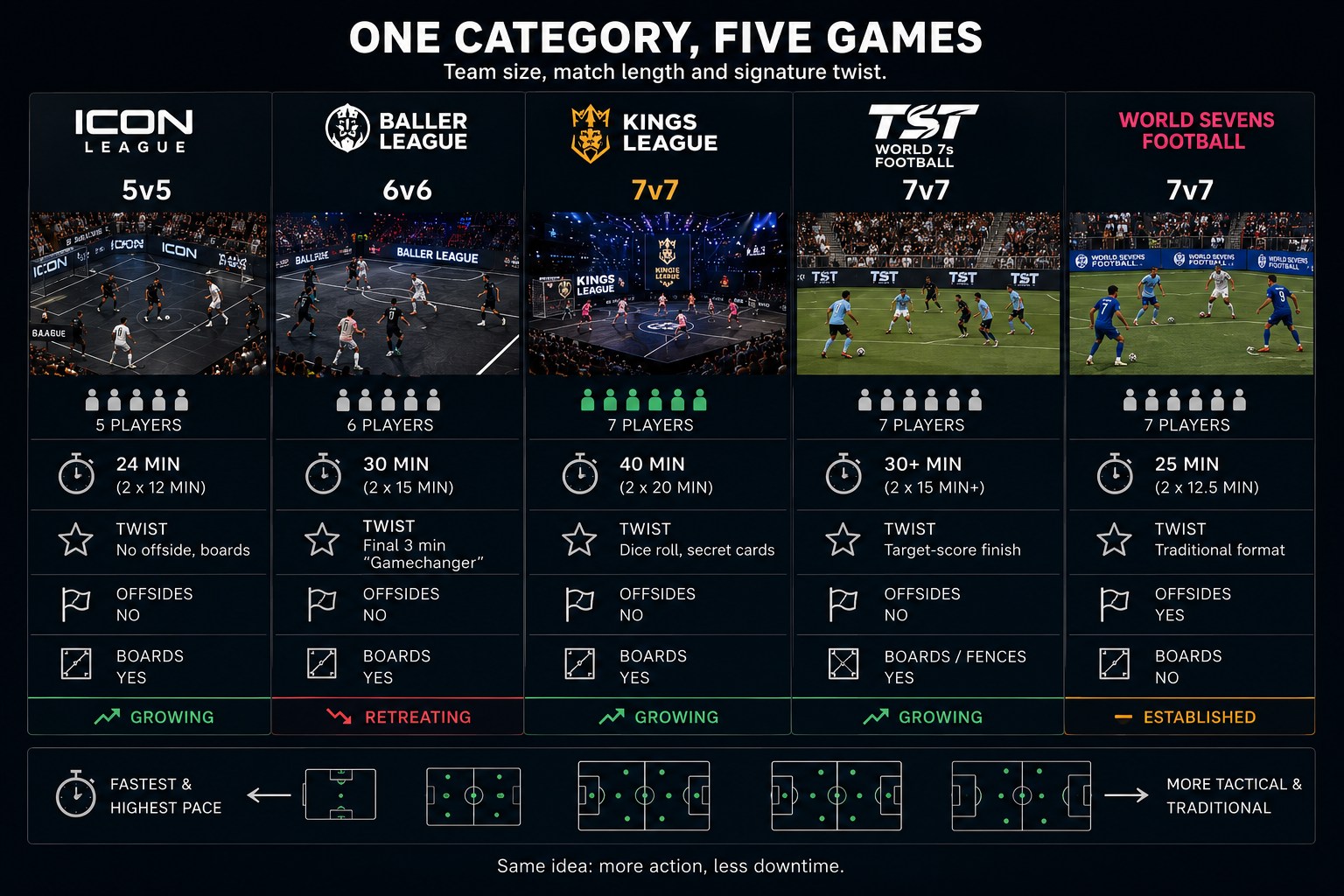
Look past the rules, though, and the dimensions that matter come into focus. On governance, all five are independent and unsanctioned — none sits inside the FIFA-to-national-federation pyramid, and that is a design choice, not an accident. By writing their own rulebooks, fielding mostly retired professionals, amateurs and streamers rather than contracted first-teamers, and owning their own distribution, three of them — Kings, Baller and Icon — never need a federation's permission to exist. Their teams are franchises — commercial units fronted by a celebrity or creator "president," rather than member-owned clubs — with rosters filled through live drafts. The other two do the opposite and plug into the establishment: TST signed a commercial partnership with U.S. Soccer, and World Sevens fields the actual women's first teams of clubs like Manchester City, Bayern and Paris Saint-Germain.
| Format | Sanction | Teams & players | Distribution | Money model | Backing |
|---|---|---|---|---|---|
| Kings 7v7 | Independent — routes around | Franchises + president; ex-pros, amateurs, streamers | Owns it — YouTube / Twitch | Sponsorship-led (~65%) + media, tickets, merch | Kosmos + Alignment Growth |
| Baller 6v6 | Independent — routes around | Franchises; pros / designated / creators | YouTube + Sky (UK) | Sponsorship + media rights | EQT Ventures + Apex |
| Icon 5v5 | Independent — routes around | Franchises; ex-Bundesliga pros + amateurs | Livestream / social | Sponsorship + prize purse | HV Capital + family offices |
| TST 7v7 | Plugs in — U.S. Soccer deal | Open entry; pros, ex-pros, club sides | NBC / Peacock | Broadcast + $1m prize/bracket | Mugar (private) + state grant |
| World Sevens 7v7 | Plugs in — fields real clubs | Elite clubs' women's first teams | DAZN / Sky (free, global) | Broadcast + $5m prize/event | Jennifer Mackesy (HNW) |
Those choices are already sorting the field — though less by team size than by which formats can monetise the attention they generate. The Kings League is expanding across continents, with a US launch planned, and TST has upgraded from ESPN to NBC and raised its prize pool to $3m. Baller League, by contrast, suspended its German operations in early 2026 — while still unprofitable — and refocused on the larger, more commercial UK and US markets; Icon League, assumed to be the vulnerable one, instead raised fresh capital and added a season. The separating variable is scale and commercial pull: the formats with the reach, the creator firepower and the market size to convert attention into revenue are pulling ahead of those that cannot yet make it pay.
04 The contrarian read: threat, or complement?
Take the threat question directly. On the evidence, sportainment is not eating traditional football's audience — it is reaching the audience traditional football has already lost. The Kings League is 85 per cent under 34. Traditional football is the opposite: the Premier League has the oldest audience of the major leagues, with roughly a third of its viewers over 50, and even football's youngest-skewing property, the Champions League, is only about 18 per cent aged 13 to 24. The two audiences barely overlap. That points to complement, not cannibalisation — the formats are filling a demographic hole the league system has been unable to close.
The behaviour of football's own institutions points the same way. Rather than trying to shut these formats down, the establishment is absorbing them — lending them its clubs, its broadcasters and its famous names. Across 2025, sixteen elite clubs entered their women's teams in World Sevens. U.S. Soccer, the American governing body, signed a formal partnership with TST. In the UK, Sky Sports now broadcasts both Baller League and World Sevens, with figures like John Terry, Luis Figo and Arsenal's Invincibles managing teams inside the format rather than dismissing it. And even FIFA and UEFA have set up permanent "innovation" units — in-house teams that trial new competition formats and technology — instead of resisting the trend. When a governing body's answer to a supposed threat is to televise it, staff it and study it, "threat" is plainly the wrong word.
One honesty check: no study has yet measured audience overlap directly, so cannibalisation cannot be ruled out with certainty. But the available evidence — near-opposite age profiles, and an establishment that is joining in — all points one way. On what can be measured, sportainment is additive.
Which reframes the real contest. It is not sportainment versus football; it is the formats against one another — and that fight has already started. Baller League's retreat from Germany — despite some €31m raised, and while still unprofitable — is the category's first proof that attention is not a business: a large audience does not, on its own, pay for itself. The formats that survive to 2028 will be the ones that can turn attention into a profitable business — by choosing markets big enough to monetise, plugging into strong creator ecosystems, and building real revenue, rather than the ones that simply post the biggest viral peak or spend the most on prize money to rent attention they cannot keep. Scale and commercial pull, not the loudest launch, are what convert an audience into a going concern.
05 The opportunity, and the questions
The demand behind sportainment is young, digital and growing fast: 93 per cent of Gen Z sports fans consume sport through a digital channel — the exact surface these formats are built for — and the Kings League grew its annual hours watched by almost 90 per cent in two years. Set against the audience these formats exist to reach — an estimated one billion young, digital-first football fans worldwide — the category has barely started. Its single biggest event, the 2025 Kings World Cup, drew a claimed 100 million viewers across two weeks; a single Champions League final reaches around 450 million, a World Cup final some 1.5 billion. The opportunity is the distance between what sportainment reaches today and the young audience already waiting for it — and the winner will be the format that closes the most of it.
That is the unfinished business of the whole category. The audience has arrived and the money has arrived; a durable, monetised global stage — the thing traditional football spent a century building — has not. Two questions decide whether one gets built, and by whom.
The young audience and the capital are already here. The question is whether any sportainment format can convert them into a permanent global stage — the way traditional football once did — or whether these formats stay a feeder culture that the incumbent game eventually absorbs.
And if one makes that leap, which? On the evidence, the winner will be decided not by the biggest audience peak but by who can turn that audience into money — which is why Baller League's retreat from a market it judged too small to monetise, not Kings League's record final, is the more telling data point of 2026.