The 365-day stadium is a moat, not an evolution.
Three clubs — Tottenham, Real Madrid, Manchester City — have spent between £600m and €1.3bn engineering their venues to host concerts, NFL games, and multi-day residencies alongside football. The trade press calls it football's shift toward entertainment real estate. A closer look at who can afford to build it, and where it is currently breaking, tells a different story.
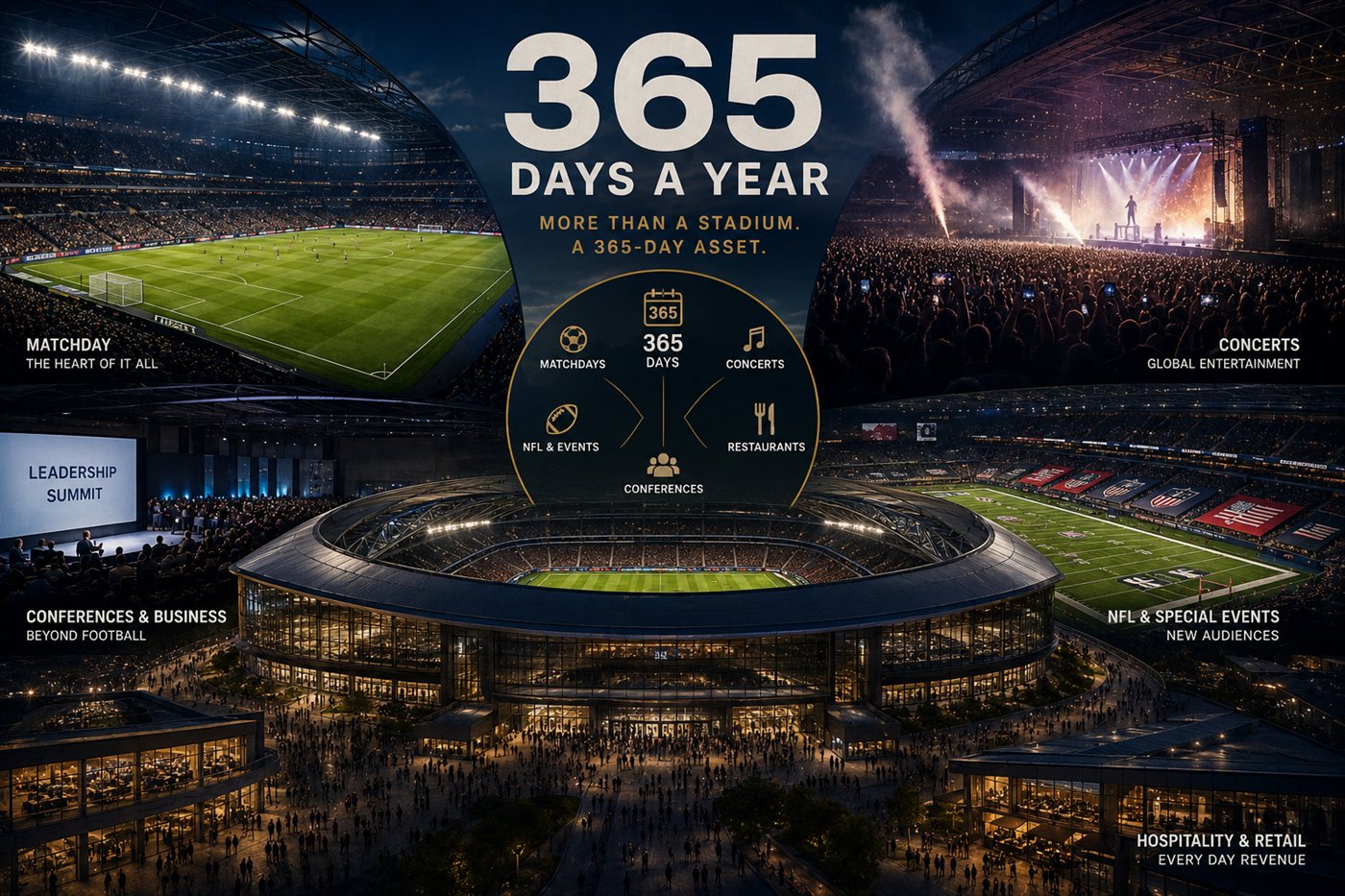
Football grounds have historically sat dormant most of the year. That is changing at the top of the pyramid, but not further down. The 365-day stadium is not the industry's direction of travel. It is a capital arbitrage available to perhaps ten clubs in Europe — and, like broadcast revenue distribution before it, may end up widening the gap it appears to close.
01 What has been built so far
A 365-day stadium is a football venue engineered — from the ground up or through a heavy retrofit — to host revenue-generating events on days when there is no football fixture. That engineering typically means a protected pitch system (retractable turf panels, underground pitch storage), sound isolation for concerts, dedicated infrastructure for non-football events, and hospitality that operates independently of matchday. Three European clubs have committed to this model at scale: Tottenham, Real Madrid, and Manchester City. Each used a different engineering solution. All three sit at capex thresholds most clubs cannot access.
Tottenham Hotspur Stadium is the clearest blueprint. When it opened in 2019 it was engineered with a retractable pitch — three grass panels that slide out on rails, revealing an NFL surface with its own dugouts, locker rooms and end zones. That single decision let Spurs sign a permanent NFL partnership, extended in 2023 through the 2029-30 season with a guaranteed minimum of two regular-season games a year. Chairman Daniel Levy has been open about the intent: recurring venue revenue the club can reinvest in football operations. Beyond NFL fixtures the venue hosts heavyweight boxing, concert residencies, and an F1-branded karting track built into the building itself. It was designed from day one to be rented out, not merely filled.
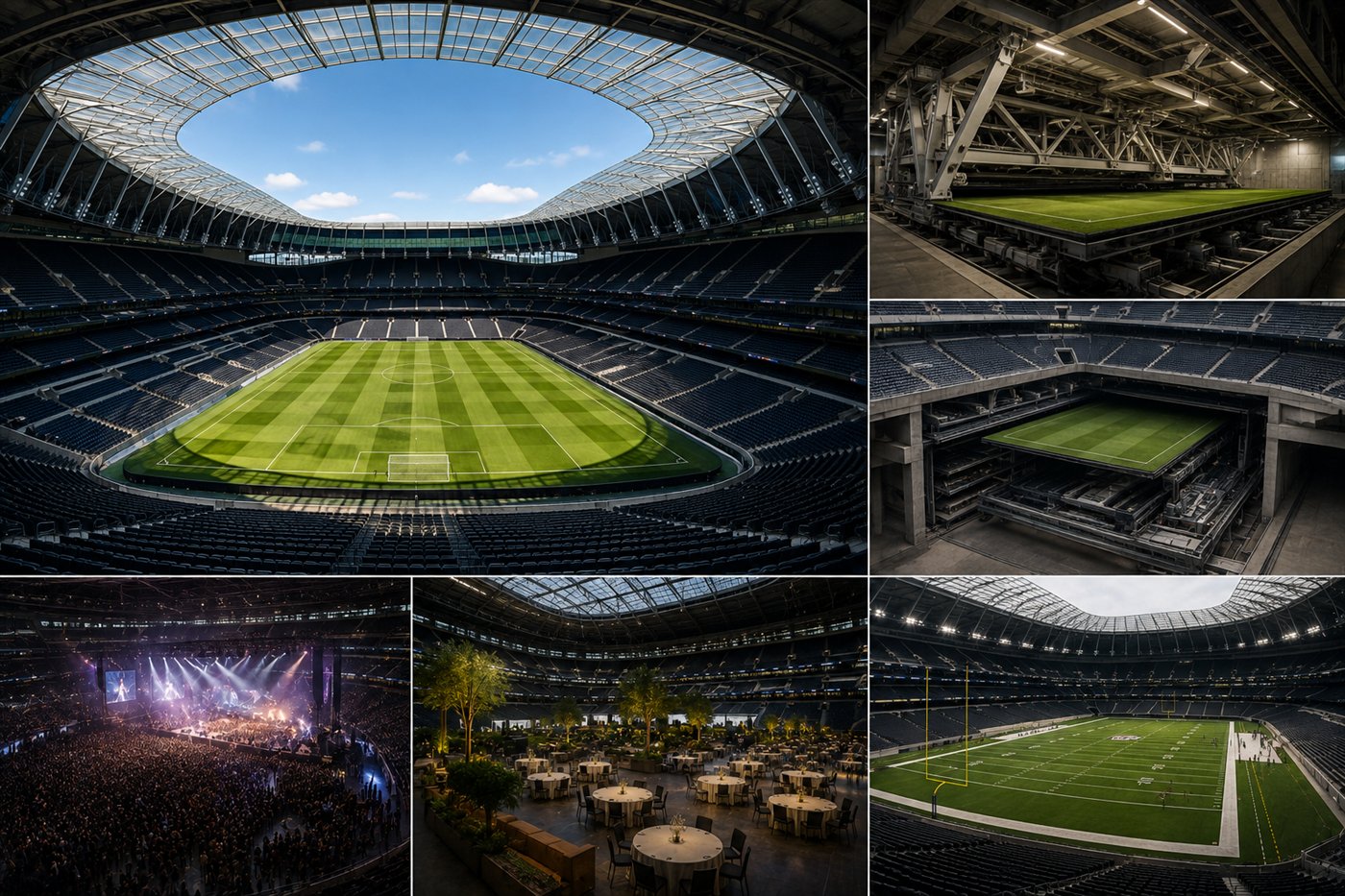
Real Madrid has pursued the same logic at a larger scale. The Santiago Bernabéu's structural renovation, completed in 2025, cost roughly €1.3 billion before financing. The signature feat is a six-layer underground greenhouse that stores the natural pitch and rolls out a concrete floor in under a day, freeing the bowl for concerts, NBA exhibitions and — in November 2025 — an NFL fixture between Miami and Washington. The club projects stadium-related income can roughly triple from about €150m a year before the rebuild toward €400m at full commercial capacity, underwritten by 300 new "Super VIP" boxes priced at €250,000 for a 30-year membership plus an annual fee, and a stadium services partnership with Sixth Street and Legends reported at up to €360m.
Manchester City is running a variant, built around a campus rather than a single retractable surface. The Etihad's North Stand opened in May 2026, taking capacity from 53,400 to roughly 61,500; the remainder of the redevelopment — a 401-bed hotel, fan zone, museum and retail — is scheduled through the rest of 2026. Alongside sits Co-op Live, the 23,500-capacity indoor arena that opened in 2024. City's disclosures describe the ambition as a year-round entertainment district, not a stadium with a car park attached.
The three programmes share a threshold: capex outlay in the hundreds of millions to low billions before a single non-matchday pound arrives. That threshold is the point. Arsenal at the Emirates and Manchester United at Old Trafford share balance sheets and ownership structures that could in principle finance similar builds; neither has attempted anything of comparable ambition. No mid-table Premier League club, and no Bundesliga side operating under member-ownership rules, has come close.
02 The forces behind the build
Why did these three clubs build these stadiums, and why now? Two forces converged, and both reward the same kind of club — the one with capital scale.
The fixed-cost problem. A modern stadium is expensive whether or not a ball is kicked inside it. Debt service on the construction loan, insurance premiums, security, staffing, groundskeeping, utilities — these bills arrive every month, regardless of when the fixtures fall. A Premier League club typically hosts around nineteen home league games a year, plus a handful of cup and European ties. That is roughly thirty match-days out of 365, which leaves over 330 days on which the venue generates almost no revenue but still costs money to keep open. Real Madrid illustrates the scale of the problem: its stadium loan grew from €575m to €1.1bn during the rebuild, and servicing that debt does not pause if the club misses the Champions League. Filling more of the calendar with paying events stops being a nice-to-have marketing add-on. It becomes a financial necessity.
The touring-demand opportunity. Global stadium-scale touring has grown from around $8bn in 2019 to over $10bn by 2024 (Figure 2). Taylor Swift's Eras Tour played 152 shows across five continents and left promoters looking for more capacity, not less. The NFL, under commissioner Roger Goodell, has made international expansion a stated priority — adding fixtures in Germany and Madrid alongside its deepening London commitments. That demand is in theory available to any club whose venue can host it.
The asymmetry. Every European club faces the same fixed-cost problem, and every European club could in theory capture some share of the touring boom. What separates the clubs able to actually do it from those that cannot is not appetite — every club would take the concert income if they could. It is capital: the ability to spend nine-figures up-front on the engineering (protected turf, sound isolation, load-in infrastructure, hospitality) that makes a venue bookable in the first place. The demand exists across football. The supply is only being built at the top. That is what turns a real economic opportunity into a top-of-pyramid concentration, and what the rest of the article traces through to the balance sheet and the rulebook.
03 The financing shift
The financial consequence is that non-matchday revenue has stopped being a rounding error and started functioning as a core underwriting input. Deloitte's Football Money League data shows commercial revenue — the aggregate bucket that captures concerts, tours, and non-football hosting alongside sponsorship — has grown to around 44 per cent of total revenue among the top 20 clubs, retaking the position as the single largest revenue category it last held before the mid-2010s broadcast boom pushed it into second place. Matchday revenue itself passed €2bn across the Money League cohort for the first time in the 2023-24 season, in part because premium hospitality and non-football events are being priced into the same physical footprint that used to generate ticket revenue alone.
That has three consequences for anyone financing a stadium project.
Debt models change. Lenders backing a stadium loan want a diversified income stream, not a bet on Champions League qualification. That is why Real Madrid's financing structure separates stadium debt from football operating accounts — the loan is serviced from stadium income (concerts, hospitality, non-football events), regardless of what happens on the pitch. If Real Madrid misses the Champions League for a season, the stadium debt is still covered.
Sponsorship gets repriced. A naming-rights deal is priced against how much exposure the sponsor gets. A pure football venue delivers roughly nineteen home league fixtures a year — nineteen days of TV cameras, foot traffic, and brand presence in that stadium. A 365-day stadium delivers a hundred-plus days, spanning concerts, NFL fixtures, tours, and conferences. That is why the Etihad Stadium and Tottenham Hotspur Stadium can command naming-rights and hospitality terms disproportionate to their footballing output alone: the sponsor is buying visibility across the whole calendar, not just Premier League matchdays.
Regulatory headroom widens. Under English football's Profit and Sustainability Rules and UEFA's Financial Sustainability Regulations, clubs can only spend on football operations up to a fraction of their income. Ownership cash injections are capped. But non-football hosting revenue — the concert income, the NFL game, the stadium tour business — counts toward allowable income. That gives well-resourced clubs a legitimate, rules-compliant route to widen the gap between what they can spend and what rivals who cannot host an NFL game can spend. It is the moat mechanism, executed inside the rules.
04 The contrarian read
Given the upside just laid out, the trade press has read the 365-day stadium as football's next industry-wide evolution. The Football Ledger reads it differently — as a model still gated by two open problems, neither of which has been solved even at the flagship level.
The financing gap. A retractable pitch or an underground pitch-storage system requires capital outlay in the hundreds of millions to low billions before a single non-matchday pound arrives. Tottenham funded its build through long-tenor bank debt (Bank of America, Goldman Sachs, HSBC), £637m in bond issuances, and internal capital from ENIC. Real Madrid financed its €1.1bn Bernabéu loan through JPMorgan and Bank of America against future stadium income. Manchester City's Etihad campus is funded by owner capital from City Football Group, ultimately backed by Abu Dhabi. Each structure assumes ownership groups with sovereign-scale balance sheets, listed-market access, or the ability to raise long-tenor bond debt against future revenue projections. Most Premier League clubs outside the top six — and most Bundesliga clubs operating under 50+1 member-ownership rules — cannot access any of these routes. Without a different financing mechanism, the model stays at the top.
The operational gap. Even clubs that can afford to build a 365-day stadium are finding they cannot always afford to operate it. Real Madrid's flagship is the current case study. When the Bernabéu opened its concert programme in 2024 with residencies by Taylor Swift and Karol G, noise complaints from residents in the surrounding Chamartín district escalated into a criminal complaint. In September 2024 the club suspended its entire concert calendar rather than continue testing Madrid's environmental rules. Two years, several soundproofing upgrades, and a May 2026 court ruling clearing the club's management of criminal liability later, large-scale concerts still had not properly resumed at the stadium as of mid-2026 — and promoters had, in the meantime, redirected major tours to rival Madrid venues including the Metropolitano and Iberdrola Music.
The pattern is not unique to the Bernabéu. Nearly every stadium currently pursuing a 365-day programme sits inside a residential planning context that carries noise, traffic, and event-frequency conditions. What separates the flagship is the visibility of its problem, not the presence of one. Whether these constraints can be engineered around, litigated away, or regulated into a new equilibrium is the industry's live experiment.
What is not in doubt is that the 365-day stadium requires two problems solved: writing a nine-figure cheque, and securing a permission that money alone cannot buy.
If the operational gap solves first, only the ten clubs that could already afford to build it benefit — and the top-to-mid gap widens. If the financing gap solves first, the model spreads down the pyramid and competition sharpens. The question is which gap solves first.