The 2027 Premier League reset runs through a courtroom.
The disruption reshaping UK football broadcasting is not the streamer wave the market spent three years watching for. It is a legacy television company running an auction and a corporate takeover on parallel tracks — and its outcome now runs through an American antitrust court.

In November 2025, Paramount won the UK Champions League rights in an auction, taking them from TNT Sports. A month later it went after the same rival from a different angle — bidding to buy TNT's parent, Warner Bros. Discovery, an acquisition that would fold TNT's still-live Premier League contract into Paramount by ownership rather than by tender. On 24 July 2026 a US judge froze that takeover until a trial verdict or 1 June 2027, whichever comes first. The next Premier League rights cycle now depends on an American antitrust court — and on a company that looks like a streamer but sells sport the way a television network does.
01 Paramount's two paths to UK football
The auction and the takeover are the same strategy on parallel tracks. The first track was the one everyone saw. TNT had paid about £915m for the current three-year Champions League cycle; Paramount bid well past £1bn for four years from 2027-28 and took most of the package. Sky picked up the Europa League and Conference League — 342 games a season, and the first time those have sat apart from the Champions League in the UK. Amazon retained one thing: first pick on Tuesday nights. TNT was left with the Premier League and the FA Cup, both running to 2029.
That left Paramount holding the Champions League it had just won and eyeing the Premier League contract it had not. Rather than wait for the 2029 tender, it opened a second front. Warner Bros. Discovery had already agreed an $82.7bn deal with Netflix for its studio and streaming assets — but Paramount bypassed it, taking a rival offer directly to WBD shareholders. Two rejections later, the bid was raised to $31 a share: $110.9bn for the whole company, Discovery Global networks included. The WBD board preferred it, Netflix withdrew in February 2026, shareholders approved in April, and both the US Department of Justice and the European Commission cleared the deal shortly after.
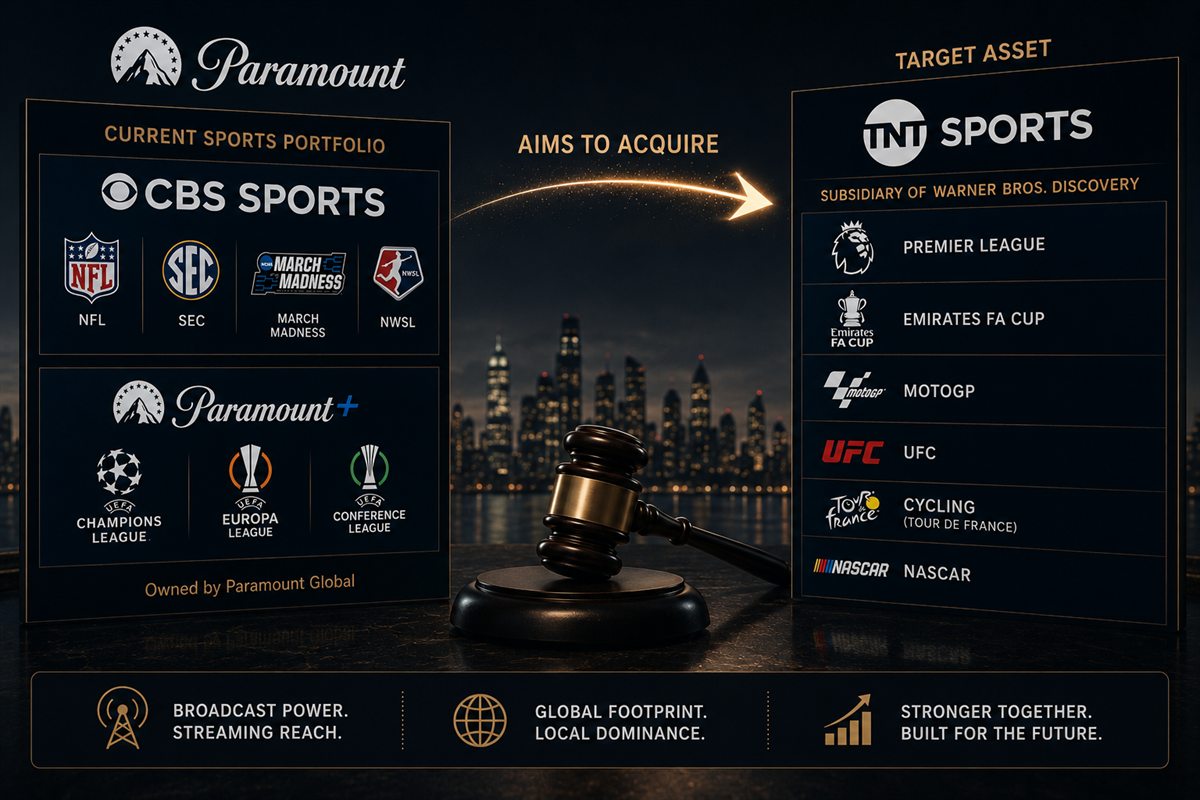
What Paramount is buying is a legacy TV business. CBS Sports (broadcast) sits on one side, Paramount+ (streaming) on the other, and — if the merger clears — TNT (cable) and the Discovery Global networks (cable portfolio) bolt on alongside them. That combination — broadcast, streaming, cable — is a television company's asset stack, not a streamer's. Paramount is running the football-rights cycle the way a television company would: bid where the auction is open, buy where it is not. For three years, the trade press predicted a streaming wave — Netflix, Apple, DAZN — would finally take UK football rights. The reality is different. The disruption reshaping the next cycle is coming from a legacy television company.
02 The courtroom clock
The takeover — Paramount's second track — now depends on a single ruling. Twelve state attorneys general and the Writers Guild of America sued to block the merger, and on 24 July 2026 Paramount agreed not to close — and not to begin combining operations — until five days after a ruling on the merits or 1 June 2027, whichever came first. The delay is not free: from 30 September 2026, Paramount owes WBD shareholders about $7m a day, or roughly $650m a quarter — a ticking fee that, held to the June deadline, would add around $1.7bn to the total consideration.

If the merger ultimately completes, one company will hold the UK Champions League contract and the UK Premier League contract at the same time, and Paramount has already said it intends to merge CBS Sports with TNT Sports once the deal closes. If it fails, TNT re-enters the 2029 Premier League tender as a subsidiary of a company still bleeding legal costs from a US antitrust fight. Either outcome resolves inside the same 18-month window, and either way, the shape of the UK's next football-rights cycle is set by that ruling rather than by anyone's bid.
03 The contrarian read
Two things are missing from most coverage of this cycle.
The first is what a Paramount victory in court would actually build. The 12-state antitrust lawsuit is being read in the trade press as a merger-approval question — will the deal close, will the divestment package hold, will the DOJ's clearance survive state challenge. Framed that way, the outcome is procedural. But if Paramount wins, it does not just take TNT's UK Premier League contract. It also merges CBS Sports and TNT Sports into a single US operating unit, holds the Champions League from 2027, keeps the FA Cup, inherits TNT's NBA and MLB packages, and — through the combined Paramount+ subscriber base and legacy CBS carriage — becomes a UK football and US sport consumer base at a scale Sky, DAZN, and every streamer would have to price against for the following decade. The antitrust case is not decorative. It names the actual competitive stake, and it may be the only leverage available to prevent a Paramount-led consolidation of UK football broadcasting for the next cycle and possibly beyond.
The second is what this proves about the streaming-native disruption thesis. The Ledger argued in Streaming-native limits that the Netflix of football is not coming — that a football subscription proposition only becomes justifiable to the consumer when it broadens on at least one of two axes: content breadth (football alongside other sport or non-football content) or distribution breadth (across streaming and traditional TV channels). The observed failures — DAZN's Ligue 1 standalone, the original Apple–MLS Season Pass — sat in the same quadrant: single league, streaming-only, neither axis broadened. The winners have always sat in the opposite quadrant, the one macro-08 named Configuration 2 — both axes broaden. Sky, beIN and TNT lived there alone before this cycle. Paramount is now joining them, combining broadcast (CBS Sports), streaming (Paramount+), and, if the merger clears, cable (TNT) across a multi-sport portfolio (NFL, UFC, college football, and now UK football). Paramount is not disproving the earlier argument. It is the empirical proof of the configuration macro-08 said would win.
The Premier League runs its next UK auction in 2029. Sky will bid — its football business depends on the Premier League. Paramount will fight more aggressively still — losing the Premier League after paying to acquire TNT would unwind the portfolio it set out to build. Two well-capitalised bidders, both strategically committed to winning, is the auction dynamic that pushes prices up.
The question the 2029 cycle will answer is whether Sky can afford to defend at the new price — or whether Paramount takes the Premier League into its consolidated portfolio and sets the price of UK football broadcasting for the decade that follows.