The manager isn't the unit anymore. The cluster is.
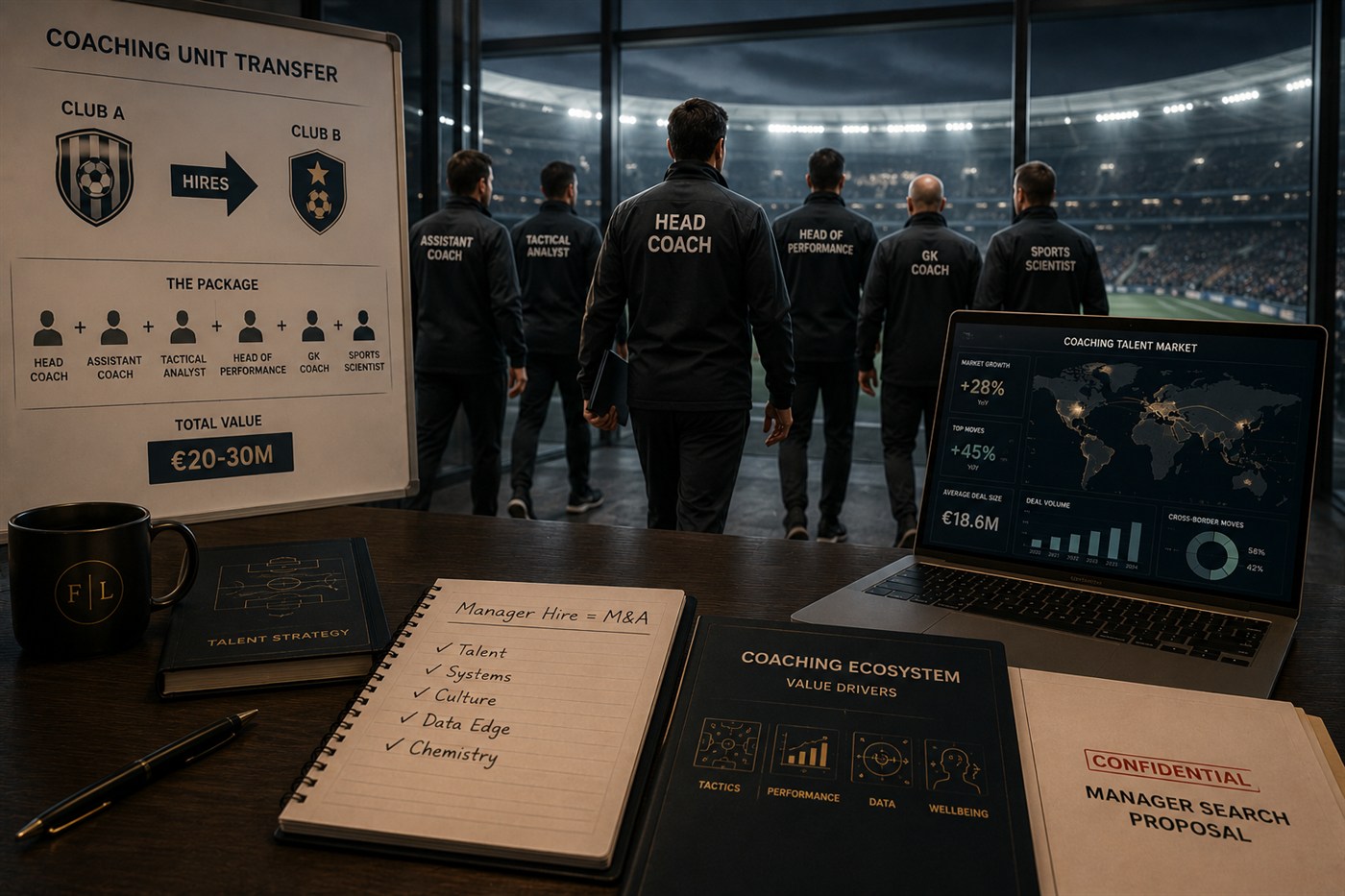
Top managers no longer arrive alone. A recruitment lead, a sports-science head, a video-analysis lead and a trusted assistant now move as a package — and increasingly the whole group is represented by one agency rather than negotiated club by club. The question the industry hasn't settled: is that cluster a personal support system, or is it becoming a piece of intellectual property clubs are quietly bidding on?
In July 2021, Arsenal paid to extract Nicolas Jover from Manchester City's coaching staff — a set-piece specialist Mikel Arteta himself had recommended to Pep Guardiola two years earlier while he was still City's assistant manager. The trade press covered it as a single, tidy hire, a manager topping up his backroom with a proven specialist. The deeper mechanism ran further back: Arteta was reassembling a working unit he had helped build at a previous club, one part at a time, because the unit itself — not any single member of it — had already been proven to produce results. The two-year gap between the men's paths splitting and rejoining is the tell: long enough that Jover built an independent track record at City (a Premier League title, a Champions League final) before Arsenal paid to bring him back into Arteta's orbit. That gap shows a manager waiting for the market to validate someone he already trusted, then paying to reunify the system once it had.
01 Why the cluster moves together
The mechanical explanation is trust under time pressure. A head coach gets roughly one season, sometimes less, to prove a philosophy works before a board loses patience. Nobody rebuilds a recruitment model, a load-management protocol and a set-piece program from scratch in that window with strangers. Arteta didn't spend the summer of 2021 auditioning set-piece coaches; Jover had already executed a version of Arteta's ideas at City, where Arsenal's own analysts could watch the receipts for two seasons before making the call.
Enzo Maresca's move to Manchester City this summer follows the same logic, and the underlying numbers make the pattern legible rather than anecdotal.
Roberto Vitiello has worked at Maresca's side since their playing days at Parma and followed him through Leicester and Chelsea into the assistant manager's chair at City. Danny Walker made the same journey from City's own academy to Leicester and Chelsea and back again. Willy Caballero, Michele De Bernardin, Marcos Alvarez, Denis Silva and Javier Molina all arrive with the same lineage, several of them already part of Maresca's staff at Chelsea before the move. City's own language treats the appointment as importing a functioning system rather than filling seven vacancies.
What this specifically proves is that clubs are no longer hiring for credentials on a role-by-role basis. They are hiring for a rehearsed operating system, and treating the people who run it as inseparable from it.

The second driver is representation, and it's newer than the loyalty pattern itself. Coaching-and-staff representation is consolidating on the same path player representation took, with a visible lag. CAA folded the coaching-focused Kauffman Sports Management Group into its basketball operation in February 2020 — roughly eight months after acquiring the player-focused Base Soccer Agency. Excel Sports Management launched a dedicated Coaching and Executives division in October 2022 by acquiring Harlan Sports Management, giving it more than twenty NFL and NCAA head coaches and front-office executives as clients — a similar pattern to the player-side acquisitions the larger agencies had already made years earlier.
Coaching agencies used to be a fragmented, relationship-driven cottage industry — an agent handling one manager's contract and maybe a second client on the side. That structure is consolidating fast, and the entities doing the consolidating are the same mega-agencies that professionalised player representation: CAA, Excel, Wasserman. Wasserman has completed more than twenty acquisitions since 2020 across its sports, music and talent businesses, and runs a standing Sport Coaches & Executive Office practice that markets direct relationships with search firms across the NCAA and major leagues. None of this is happening because agencies suddenly discovered goodwill toward coaches. It is happening because the same firms that learned how to price a player's value now have a template for pricing a coaching staff's value, and they are applying it on a lag of roughly one to three years behind the player-side deal that preceded it.
The sharper signal here is that representation is moving up the org chart faster than the org chart itself is changing. Clubs still hire a head coach and let him build a staff informally, deal by deal. Agencies are already positioned to sell that staff as a bundle, with a single negotiation covering four or five contracts at once.
02 What changes for clubs

The practical consequence is that recruiting a manager now means underwriting a supply chain a club doesn't fully control. A head coach's release clause used to be the headline number in a managerial appointment. Increasingly, the real cost sits underneath it: buying out three or four staff contracts simultaneously, absorbing whatever internal restructuring displaces the incumbents, and accepting that the new manager's honeymoon period runs shorter if the cluster arrives incomplete — because the systems that made him effective elsewhere depended on people, not just a philosophy on a whiteboard.
It also concentrates risk in a way boards have been slow to price. When a manager leaves a club, the departures that typically follow among his closest staff represent the other half of the operating model leaving with him, piece by piece, over the following seasons. A club that hires a manager without asking who else needs to come, and on what terms, is buying half a system and hoping the rest holds together on its own.
There is a talent-development cost layered underneath that. If elite recruitment leads, sports-science heads and analysts move as a fixed unit tied to one manager's career, fewer of them get tested independently against different philosophies, and fewer emerging staff get a genuine shot at running a department solo before they are 40. The cluster model rewards continuity for the people already inside a proven unit and narrows the door for everyone circling the outside of it.
03 The trade press's read, and the Ledger's
The conventional framing treats these hires as loyalty stories: a manager rewarding people who have earned his trust, nothing more structurally interesting than that. There is truth in it. Loyalty is real, and it is part of why these relationships survive the pressure of a bad run of results when a purely transactional hire would not.
The Ledger's read is that loyalty is the surface description of something closer to a licensing arrangement. What is actually being transacted — whether or not anyone in the room calls it this — is a proven operating system: a recruitment methodology, a load-management protocol, a set-piece program, bundled with the specific people who know how to run it and calibrated to work together. The premium a club pays covers the time it would otherwise take to build those systems from scratch with strangers, compressed into three or four linked signatures instead of one. The agencies now representing these clusters understand that the value sits in the bundle, not in the individual line items — which is exactly why consolidation among coaching agencies is accelerating on the same track player-agency consolidation already ran.
Within three transfer windows, at least one club in England's top two divisions or one of Europe's other top-five leagues will make public a contract structure that names a defined backroom cluster explicitly — not just a release fee for the head coach, but a linked buyout schedule for two or three named staff, with break clauses tied to the manager's own departure date. That single disclosed clause, whenever it surfaces, will be the moment the market stops pricing these clusters as loyalty and starts pricing them the way it already prices image rights and data.