Football stopped selling clubs. It started selling claims on them.
FSG's sale of a Liverpool stake was reported everywhere as a minority investment. Read the terms and it is a two-stage sale, with the second stage already priced.
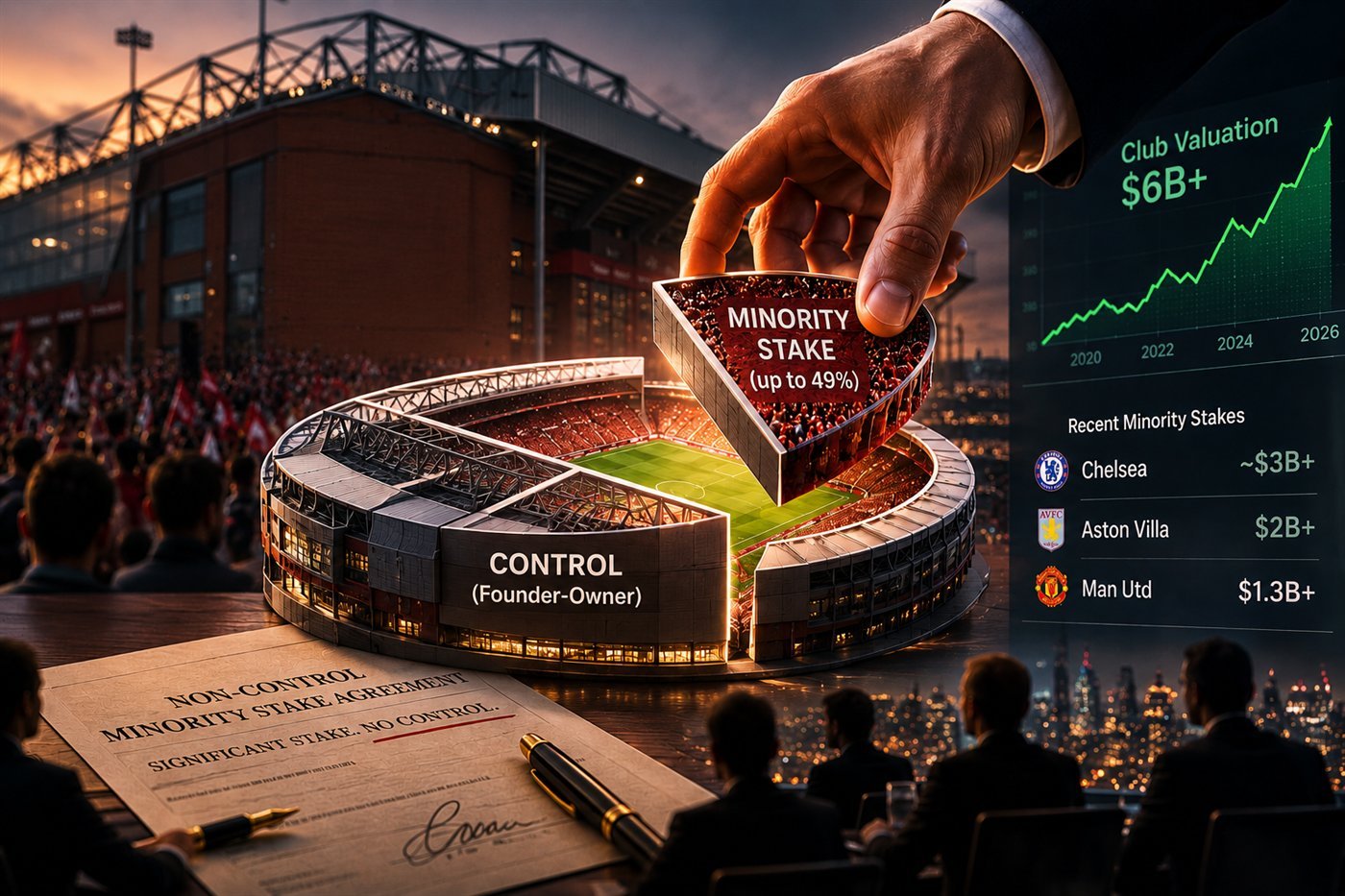
There are two numbers in the agreement Fenway Sports Group signed on 14 August, and only one of them made the headlines. The first is just over £2bn ($2.7bn), the price 1892 Holdings paid for a 38 percent stake in Liverpool Football Club, revised upward from an initial 30 percent estimate after the Athletic, the Guardian and the Times corrected the figures on 18 August; Sky Sports independently puts the stake at "closer to 40 percent." The transaction values the club at roughly £5.5bn ($7.45bn) on a minority basis. The second number is $8bn, the valuation reported for 1892 Holdings to move to majority ownership within twelve months, a figure neither side has confirmed. That second number did not appear in most of the coverage. It is the more important one.
01 The stake and the strike price
Call the deal what its structure says it is, not what the press release says it is. FSG has not brought in a passive financial partner. It has signed a contract that sells Liverpool twice — once now at a minority price, and once later at a control price both sides have already fixed. The only piece FSG has kept is the decision of whether to trigger stage two. Everything else — the buyer, the price, and 1892 Holdings' first place in the queue if FSG sells more within twelve months — is written into the agreement, according to the Times and the Guardian.
The deal, as reported by the Athletic, the Guardian, the Times, Sky Sports and CNBC: 1892 Holdings — a consortium fronted by Amit Bhatia — buys 38 percent of Liverpool for just over £2bn ($2.7bn). That values the club at roughly £5.5bn ($7.45bn). The consortium's backers include the Mittal family trusts, K5 Sports (a K5 Global fund whose lead investor is Jeff Bezos), and EE Capital, the family office of Elaine and Eduardo Saverin. Bhatia joins the board as vice-chairman; Bezos does not take a seat. FSG keeps majority ownership and day-to-day control. Regulatory approval is expected within about 90 days.
Alongside that minority sale sits a separate clause the coverage largely missed. If FSG decides to sell any more of the club within the next twelve months, 1892 Holdings has the first right to buy it — at a valuation of roughly £5.9bn ($8bn as reported by the Times and the Guardian, using the FX rate implied by the minority-round terms). Neither side has confirmed that figure. FSG has said the clause does not commit it to selling anything more.
Unlike Chelsea or Manchester United, whose full-club valuations are still the subject of analyst guesswork, Liverpool's control price is now written down. What is open is the seller's timing.
02 The mechanism
Sellers do not structure deals this way by accident. A staged control sale of this kind solves three problems at once.
Liquidity without surrender. FSG gets just over £2bn in cash now — enough to pay down debt and keep up in a market where most of its rivals already have outside money. It does not have to give up the control premium a full sale would extract in one hit. That premium sits in the second stage, waiting for FSG to call it in.
Underwriting from inside. A buyer who bids straight for control has to price the club sight unseen. A buyer who starts with a minority stake, a board seat and the vice-chairmanship spends twelve months watching the numbers from inside the boardroom before FSG has to decide anything.
The ratchet. A fixed conversion price — £5.9bn ($8bn as reported), within twelve months — turns the next season on the pitch and in the accounts directly into a strike price, not a number the two sides have to renegotiate from scratch. Liverpool's most recent filed accounts, for the year to May 2025, showed record revenue of £703m. The minority price of £5.5bn works out to about 7.8 times revenue; the £5.9bn conversion price to about 8.4 times.
The gap between them — roughly £400m — is what a buyer pays for going first in the queue.
None of the first five deals in Figure 2 came with a written, dated right to buy full control at a fixed price. Ineos's Manchester United stake gets closest — Ratcliffe is reported to be favourably placed if the Glazers ever sell more — but with no priced trigger written into the agreement. The 1892 Holdings deal has one. And the roughly £400m gap between Liverpool's minority price and the reported conversion price is the part the market has not yet priced in.
03 The contrarian read
The consensus read of the deal, repeated across most of the coverage, is that FSG raised cash and stayed put, welcoming a group of wealthy new partners without changing who runs the club. That framing takes the first number and stops there.
The Ledger's read is that FSG has opened up the possibility of an eventual exit, on pre-agreed terms, while publicly saying that exit is not part of its plans. It has kept only the discretion of whether to act on those terms. A control price both sides have signed off on, with the buyer locked into first place the moment FSG decides to sell more, is functionally an option on FSG's own future — even if FSG never uses it. The label — minority investment — describes the legal form of the first payment. It does not describe the economic substance of the whole agreement, which pre-prices a full transfer and pre-selects the buyer, leaving open only whether and when FSG chooses to trigger it.
Two things about that read deserve to sit alongside it. FSG has said on the record that the arrangement is not part of an exit strategy and that it is not committed to selling any more of the club. Nothing in the reported terms forces it to. If the first-refusal right is never triggered, it simply never activates — and FSG stays in the same control position it holds today, only richer by just over £2bn. The structure is not a certainty of transfer. It is an option only the seller can activate.
That distinction changes how every other minority stake in the sport should be read as a comparable. When analysts value PSG off Arctos, or City Football Group off Silver Lake, or the next minority sale off FSG's own 2023 deal with Dynasty Equity, they treat those prices as a clean read on what a fraction of a club is worth. If the FSG-1892 Holdings structure becomes the template, that comparison breaks. A minority price signed alongside a dated, priced right of first refusal is not comparable to one signed without it — because part of what 1892 Holdings paid for was the priority position on a future control transfer, and that price sits in the second number, not the first.
The FSG–1892 Holdings structure is going to become the default template for how controlling owners in European football take money off the table without admitting they are leaving. It lets a seller pre-sell control on its own terms while publicly denying any exit plan — and it lets a buyer buy a priority position on a control transfer without owning any of the seller's obligations to trigger it.
The FSG–Liverpool structure is a template other controlling owners in European football can now use to sell control without saying so. The strategic question is which clubs move next — and, more consequentially, how much a priority-position buyer is willing to pay for the second stage. Liverpool set the premium at roughly 7% (£400m on a £5.5bn minority valuation). Is that enough to make the buyer side willing to hold first place on the next staged-control deal, or does the market bid it materially higher?