The club that sells a lake.
Como 1907 rose from bankruptcy to the Champions League in six years, and it is the smartest brand-building operation in football. It also lost €105m last season, and runs entirely on one family's chequebook. This year's Champions League qualification has proved the football bet worked — not that the business pays for itself.
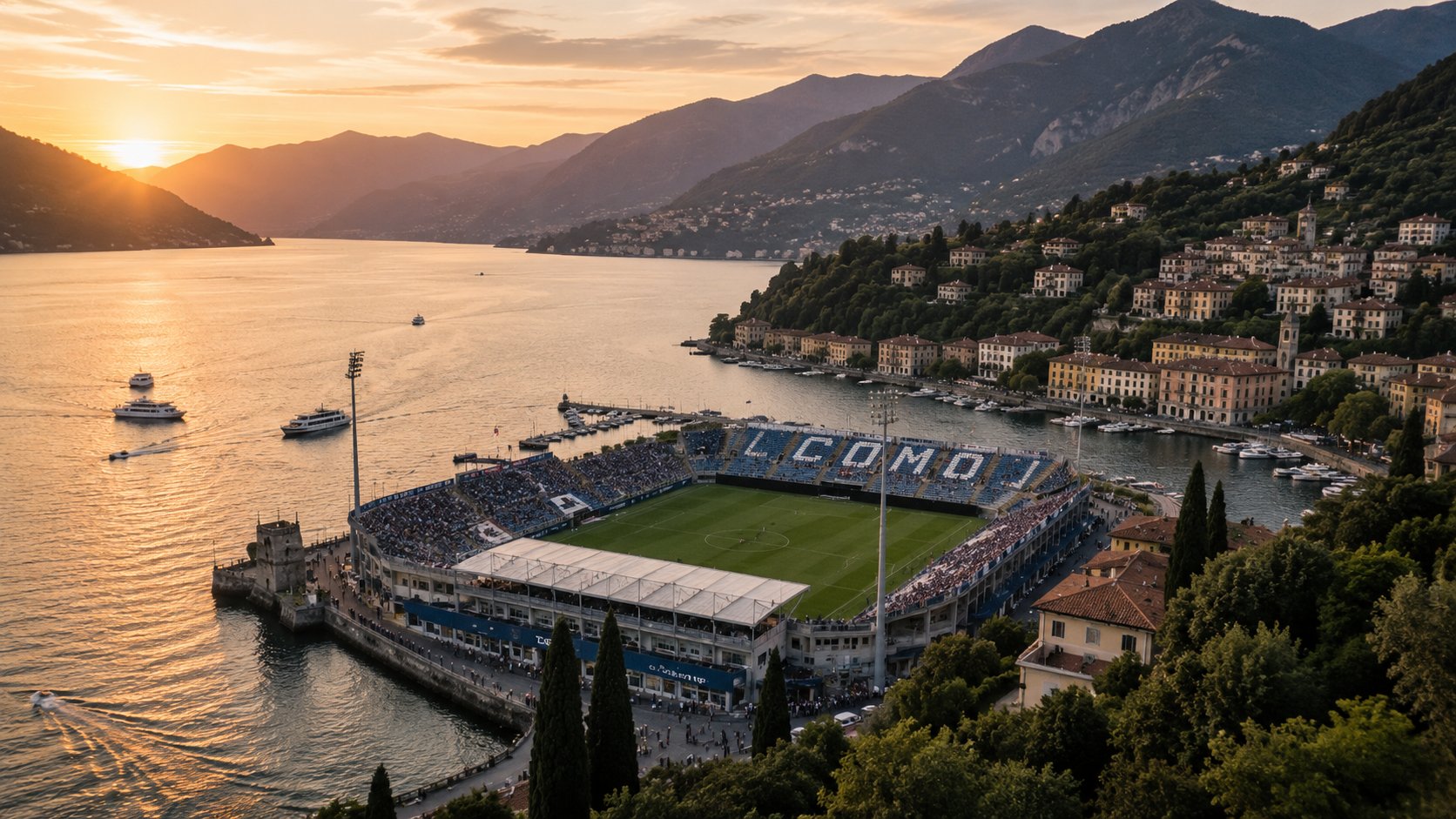
In 2019, Como 1907 was bankrupt, playing in Italy's fourth division, and drawing crowds so thin the ground was barely a third full. The Hartono family — owners of Indonesia's Djarum group, and among the richest people in Asia — bought it for €800,000. Six years later Como is in the Champions League, and it has been funded the entire way by the family that bought it. In this analysis, Como has proven what it needed to prove on the growth side of the bet: from the fourth division to the Champions League in six years. What remains open — and is the harder question — is whether that growth can convert into the sustainable business the owner has set as the goal. Six years of that funding has built something the football industry has never quite seen before: a club engineered from day one as an appendage to a luxury tourism economy, not the other way around. This is how it works.
01 How the model works
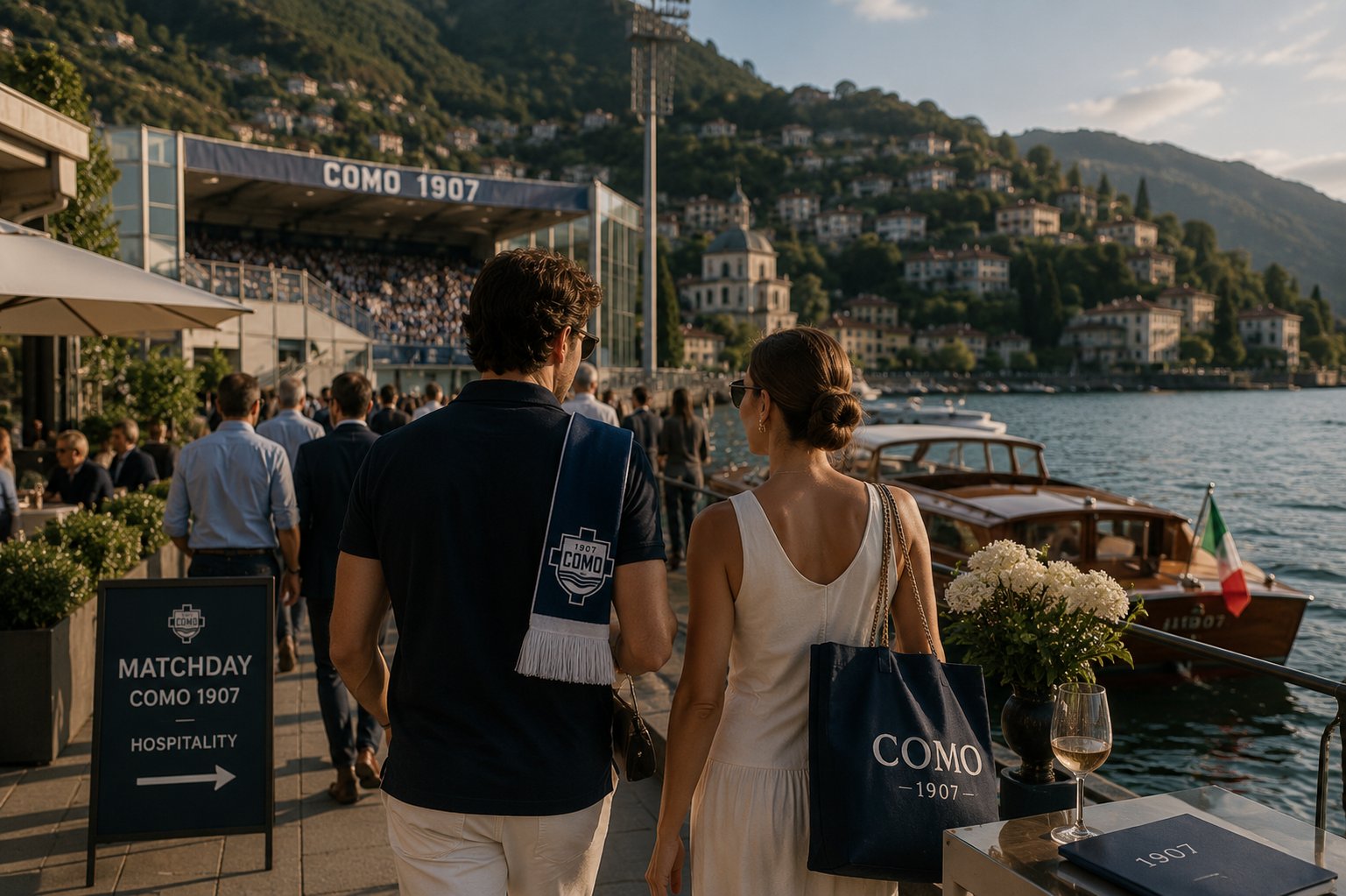
Lake Como is already one of the wealthiest tourist magnets on earth — an estimated 4.8m international visitors in 2024, up from 1.6m before Covid, long before the Hartonos arrived. None of that money touched the football club: it flowed to hotels, villas and boat tours while Como 1907 sat bankrupt and invisible in the fourth division. The Hartono play is to insert the club into that existing flow — to make a Como matchday one more thing a wealthy visitor does at the lake, alongside the Michelin lunch and the lakeside suite. "We don't have sporting ambition, we have business ambition," club president Mirwan Suwarso has said; the stated goal is a $1bn group by 2038, with football treated as one input, not the objective.
That single idea — insert the club into the existing tourist flow — drives every operational choice. The football has to be good enough to justify a tourist's afternoon, so recruitment runs through Jamestown Analytics (the same data-led model The Ledger dissected in The data-led underdog arrives in Europe) and Cesc Fàbregas coaches as head coach and shareholder. The atmosphere has to reward the effort, so the club leaned into the lakeside setting — VIP hospitality programmes with the surrounding luxury hotels, a matchday atmosphere that draws celebrity attendance, and a curated fashion presence that has made a Como fixture as photographable off the pitch as on it. And the backroom has to sell the destination, so it grew from five staff in 2019 to forty-five, most of them commercial and media rather than football.
The clearest evidence sits in the merchandise line, because it is where the tourism-first model is easiest to trace. Revenue there rose from €53,000 in 2019 to over €10m by 2024-25 — a 190× increase across six seasons, not driven by selling more scarves to locals. Como brought the operation in-house, partnered with the Los Angeles streetwear label RHUDE, and put the range across four club stores and roughly 480 affiliate outlets around the lake, aimed at international visitors and a global fashion audience rather than the season-ticket base.
Around 40 per cent of ticket revenue now comes from overseas visitors — the matchday is being priced and sold to the traveller, not the local season-ticket holder.
The sponsor mix reflects the same audience. Uber and Revolut are products built for a mobile, high-spending international traveller. The Serie A norm is domestic banks, energy companies and industrial groups selling to a loyalty-based local base. Como sells to the traveller both.
Once matchday, merchandise and sponsors are all pointed at the same traveller, the model starts feeding itself. The club's Serie A and Champions League visibility makes "Lake Como" more famous globally, which brings more visitors to convert, which lifts matchday and merch, which funds the football that keeps the club visible. The destination sells the football, and the football sells the destination — a flywheel Como is the mechanism inside, rather than the source of. That is the point of the model: Como is a toll booth on an existing luxury economy, not a club trying to build an audience from scratch. Wrexham and Inter Miami had to manufacture their audiences — from a documentary, from Beckham; Como bought a way to tax one that was already there. The tourism is the moat: it does not depend on the club staying compelling, which is exactly why the business should, in theory, prove more durable than the fairytale suggests.
02 The bill
The model is promising and revenue is growing at a pace few clubs have ever matched. Whether it becomes a sustainable business is a different question — one the audited accounts help answer.
Revenue leapt from €9.8m in 2023-24 to €55.4m in 2024-25, the first season back in Serie A — but the jump is not the tourism story. Of that €55.4m, €31.8m is Serie A broadcasting money; the matchday and commercial lines the Lake Como model is built to power are still only about €5.9m and €5.8m. Promotion, not the lake, drove the revenue — so far. Meanwhile the cost side ran away: total costs tripled to €158.6m, the wage bill alone reached €85.6m, and the club posted a net loss of €105m, up from €47.8m a year earlier. That same summer Como spent €94m net on transfers, the most in Italy, ahead of Juventus's €53m and Inter's €42m.
Even against that peer group, Como's loss margin is roughly four times the next-biggest loser — a scale that is unusual even by Serie A standards, and one only the largest promoted clubs in Europe have absorbed for more than a season or two.
Not all of the €105m is waste yet. Transfer fees are amortised over the length of player contracts, the squad carries resale value, and the stadium and brand are assets rather than sunk costs.
Strip the transfer line out and the picture is still not clean. The core operation — wages, football staff, matchday running — is not yet covered by what the club generates. Set against the broader European loss-making cohort, that gap is unusually wide even for a promoted side. Whether it narrows fast enough is a question of sustainability, not ambition.
03 The contrarian read
The trade press has largely settled on a verdict: the investment has paid for itself. On the club's own numbers, not yet. Champions League qualification is proof the football bet worked; it is not proof the business pays for itself, and the two are being quietly conflated. Set the transfer line aside and an operating gap still sits underneath — the wage bill, the football operation, and a commercial ramp-up that revenue has not caught. Champions League money will not close it on its own: for a first-timer the sums are meaningful but small next to the loss they are meant to be shrinking, and qualification usually raises the cost base rather than lowers it — better players, higher wages, bonus structures. The commercial engine that is supposed to do the closing — merchandise, international matchday, the sponsorship the Lake Como brand commands — is still a modest share of the top line. A business built on someone else's tourism still needs its own numbers to close, and they do not, yet.
04 The question
Michael Bambang Hartono's death in March 2026, at 86, matters more than an ownership footnote. He was one half of the family absorbing the annual gap; his brother Robert Budi retains the majority stake through the Djarum group. Ownership is stable — appetite is what has not yet been tested.
Every long-horizon single-family sports project reaches a generational handover, and each handover re-underwrites the original bet. The next generation of Hartono decision-makers inherits the annual outlay, the $1bn-by-2038 stated ambition, and a commercial engine — AlUla in Saudi Arabia, the RHUDE 4 FANS luxury-fanwear licence — that is still at pilot stage. Whether they hold the same conviction, at the same rate, is the question the model now rests on.
By the end of the 2027-28 season, either Como's commercial revenue will have closed meaningfully on its €105m loss — proving the tourism engine can catch up to the wage bill — or the next generation of Hartono decision-makers will be the ones deciding whether a subsidised showcase still counts as a business worth funding alone.