Selling a slice of the World Cup — and locking it in for good.
The obvious story is that football's richest governing body suddenly needs money. The more interesting question is why an organisation that just posted a record year would give up part ownership of its biggest asset at all.
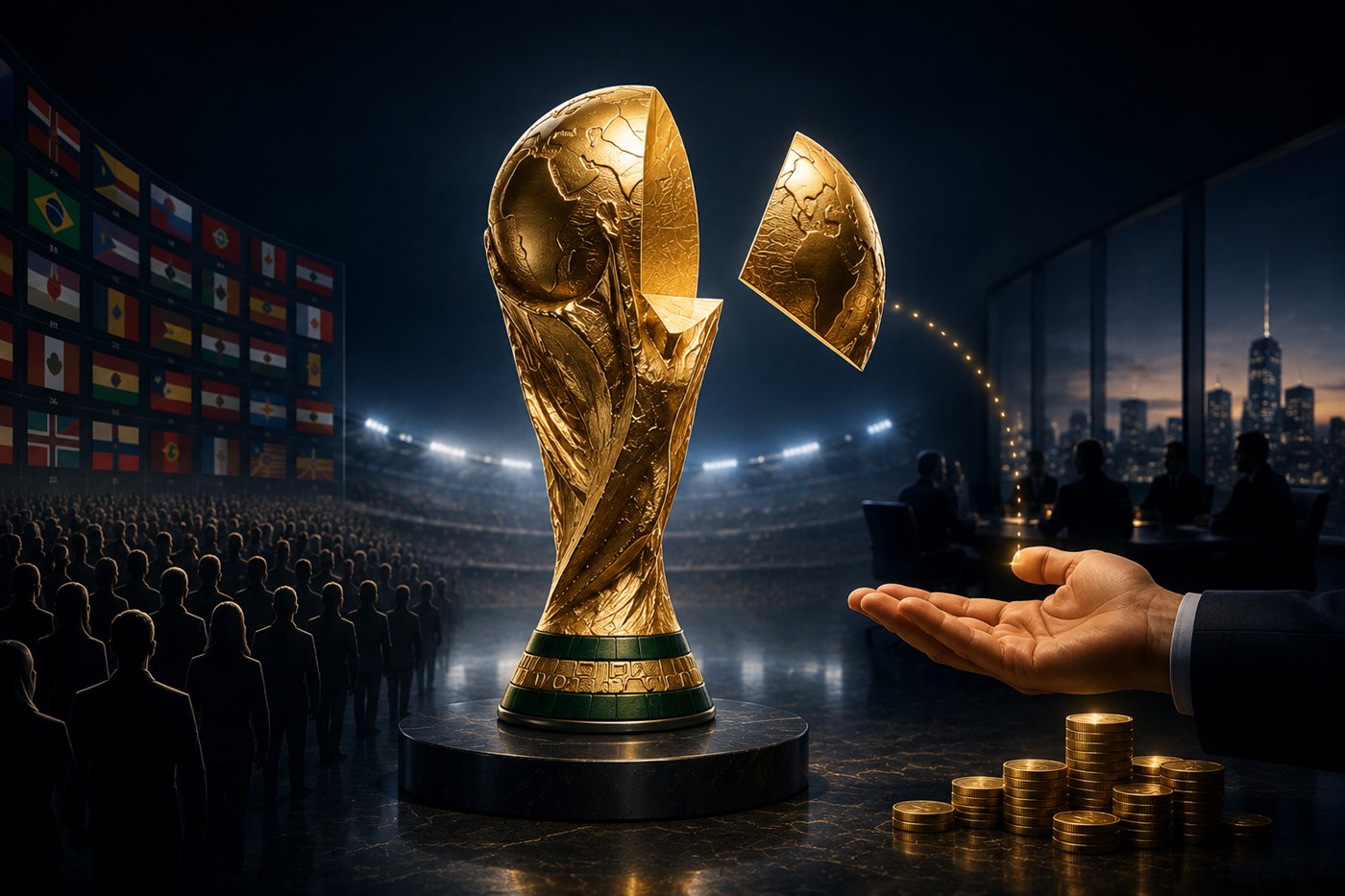
FIFA closed the books on its most lucrative World Cup ever in July 2026, when Spain beat Argentina at MetLife Stadium to cap a tournament that pushed FIFA's four-year commercial cycle revenue past $15 billion. Days later, FIFA announced it wants to sell a slice of that machine to outside investors. The obvious story is that football's richest governing body suddenly needs money. The more interesting question is why an organisation that just posted a record year would give up part ownership of its biggest asset at all.
01 What's actually being sold
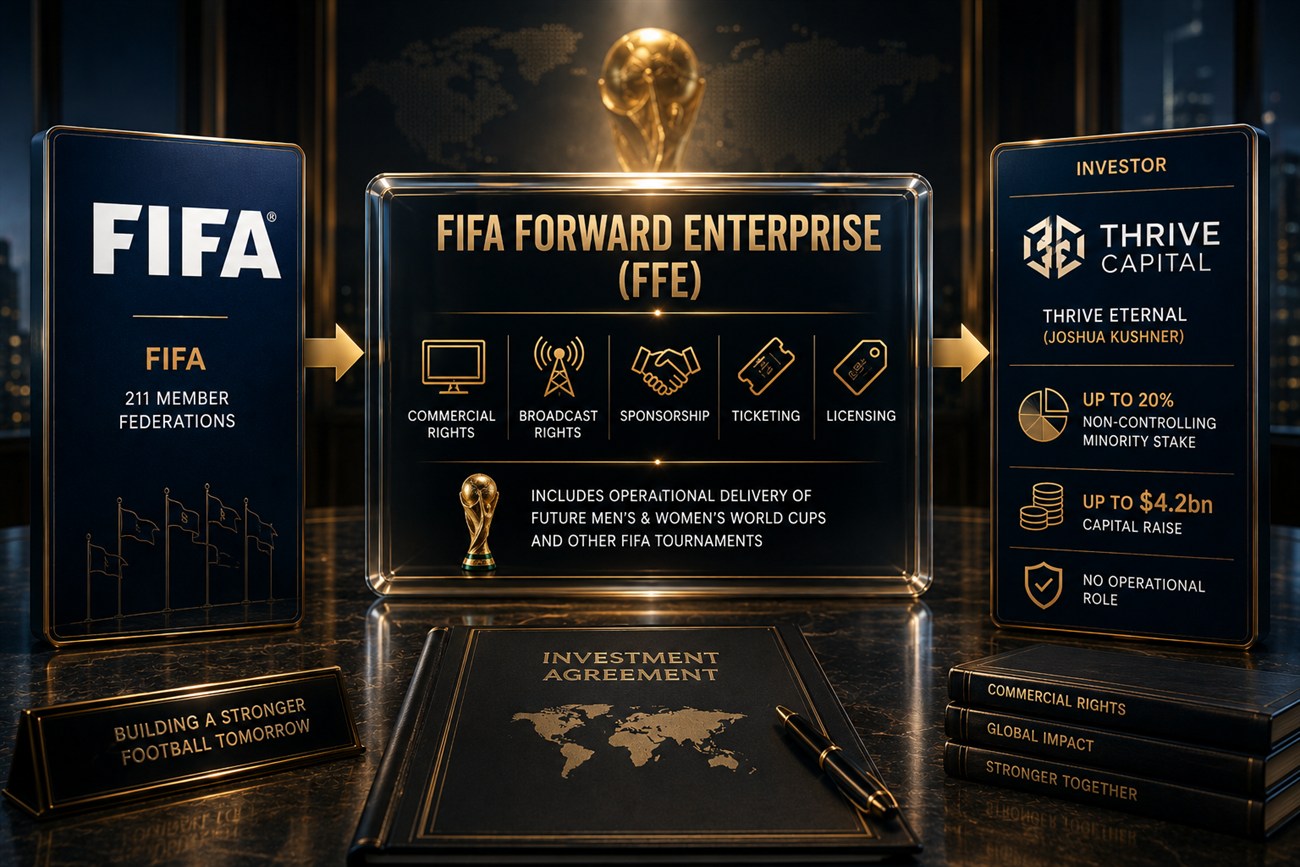
The plan centres on a new subsidiary called FIFA Forward Enterprise, or FFE — a name that happens to duplicate FIFA's long-running development-grant programme of the same title. FFE would house FIFA's commercial rights (broadcast, sponsorship, ticketing, licensing) bundled with the operational delivery of the tournaments those rights are sold against, including future editions of the men's and women's World Cup. FIFA has priced the subsidiary at roughly $20 billion and wants to raise up to $4.2 billion by selling a minority, non-controlling stake of up to 20 per cent to outside investors.
The lead name in that group is Thrive Capital, through its permanent-capital vehicle Thrive Eternal, run by Joshua Kushner — brother of Jared Kushner, Donald Trump's son-in-law. J.P. Morgan is advising FIFA on the deal. FIFA, a Swiss-registered non-profit association of 211 national federations, says it would retain sole control of FFE through majority board representation, along with exclusive authority over governance, competitions, the match calendar, and all sporting and regulatory decisions. Outside investors would get an economic stake with, in FIFA's words, no operational role. Any change still needs approval from a majority of FIFA's member associations and its 37-member Council. FIFA says the deal would let each of its 211 federations access up to $20 million in one-off capital, and has framed the plan — in president Gianni Infantino's words — as a step toward the "democratisation of football worldwide."
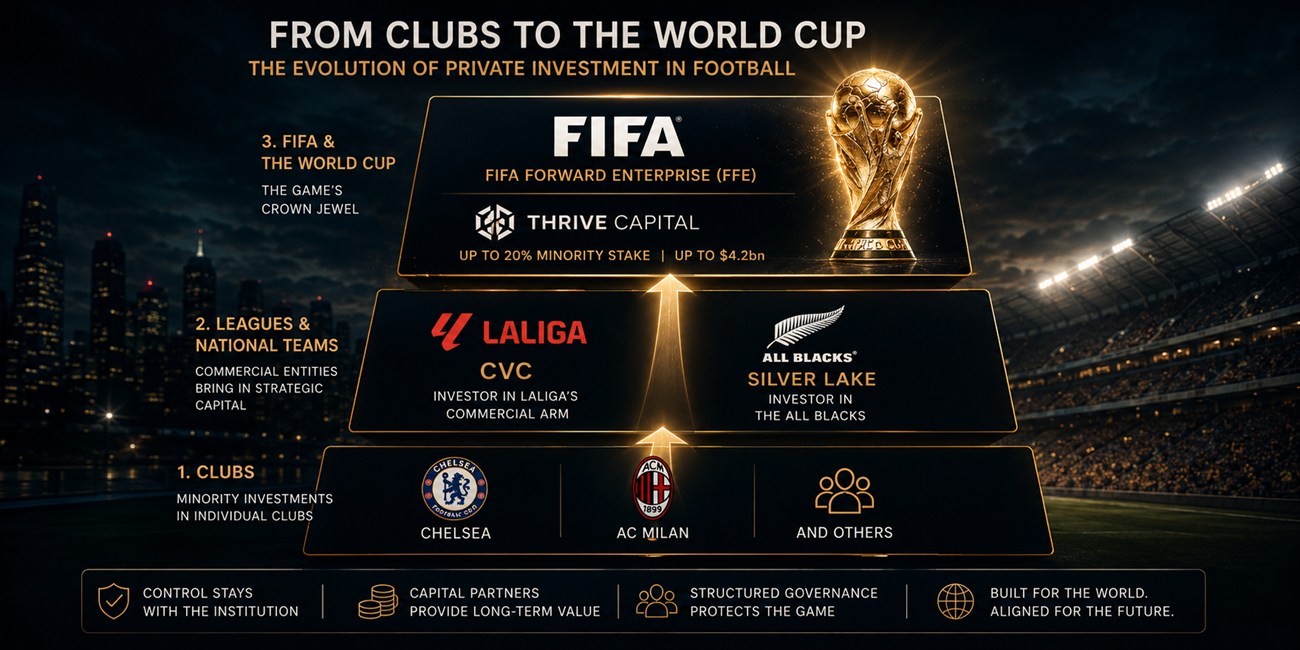
Structurally, none of this is new to sport — only to FIFA. Spain's LaLiga sold a stake in its commercial arm to CVC in 2021. New Zealand's All Blacks brought in Silver Lake around the same time. Both deals kept the underlying institution in charge day to day while giving an outside investor a fixed, contractual claim on future commercial income. What is new is applying that template to an event that no single body owns in the way a league owns its broadcast rights — which is exactly what has made FIFA's version so much more contentious than the ones that came before it.
02 Why, if FIFA doesn't need the money
This is where the cash-strapped framing breaks down. FIFA does not have a revenue problem — the trajectory from Russia ($6.4bn) to Qatar ($7.5bn) to North America (>$15bn) is straight up-and-to-the-right, as Figure 1 shows. What FIFA has is a control problem, and a structural one.
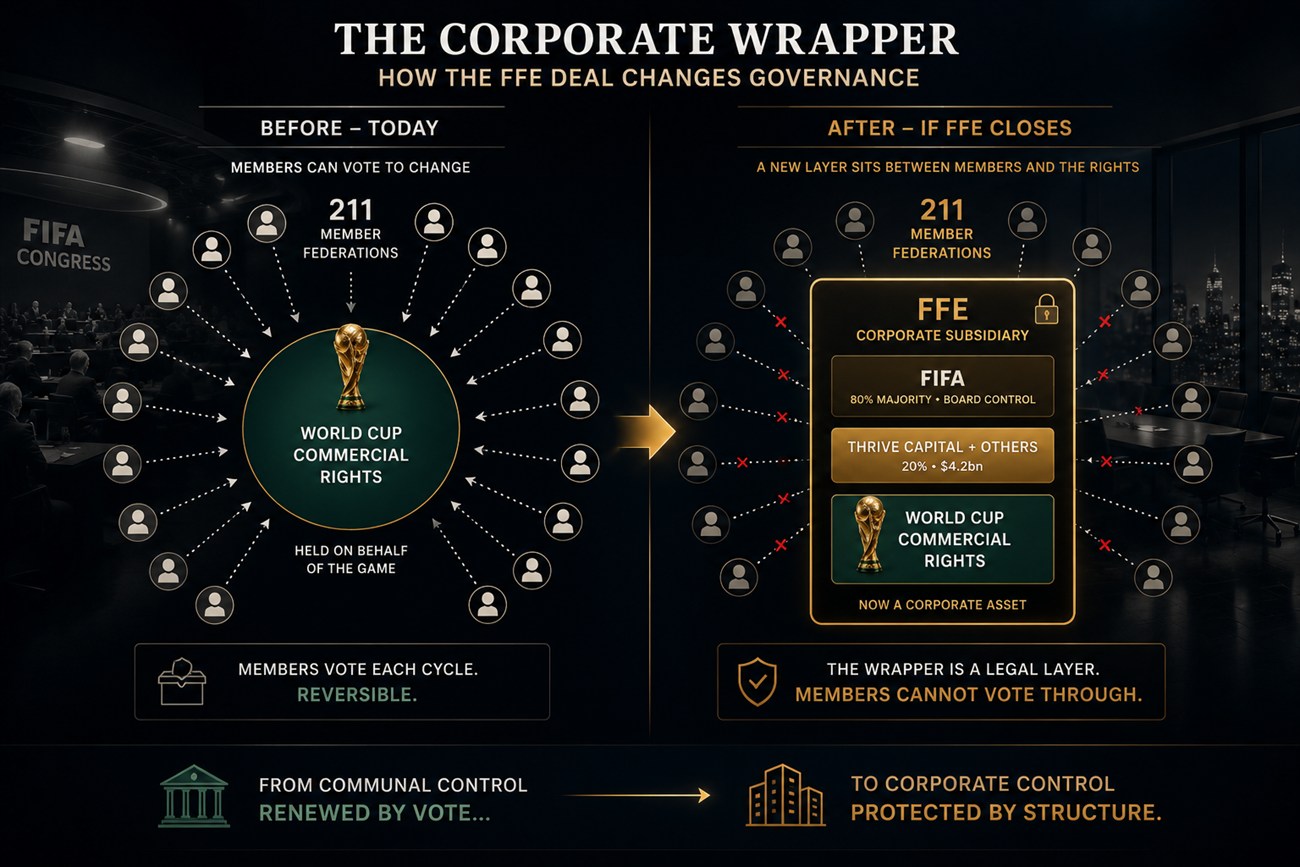
Unlike a company, FIFA does not own the World Cup outright. It runs the tournament on behalf of the game, and its authority to keep doing so is renewed by its own membership rather than held in perpetuity. Its 211 national federations vote on FIFA's constitutional questions; the commercial rights to each edition are effectively resold from scratch every four-year cycle, so no partner, and no sitting FIFA leadership, has a permanent claim on the terms of the next sale. And the large regional confederations — UEFA above all — hold something close to a veto by exit. In 2021, FIFA abandoned a plan to stage the World Cup every two years once it became clear UEFA and its members were prepared to threaten a boycott. FIFA's grip on its own showcase event is real day-to-day, but structurally loose — renewed by consensus rather than owned outright.
Folding the commercial side of that event into a corporate subsidiary, with named outside shareholders and a fixed governance charter, changes that arithmetic. A company with contracted investors is far harder for a future FIFA Congress, an unhappy confederation or a change in leadership to unwind than an arrangement that persists only because the members keep voting to renew it. Coming just over a week after FIFA's most profitable tournament ever, the timing reads less like an organisation plugging a shortfall and more like one moving to convert a loosely held communal asset into something fixed — while a record year still gives its leadership the standing to get it done.
03 Why UEFA is pushing back
UEFA's response has escalated quickly. On 30 July 2026, the confederation's 55 member associations met virtually and unanimously voted to boycott every FIFA competition — not just the World Cup — for as long as the FFE proposal remains alive, unless it is abandoned in its entirety and FIFA gives binding assurances that it will never again open governance or competitions to private ownership. UEFA's public statement was blunt: "The World Cup cannot be treated as an investment product. No part of it should ever be surrendered to private investors. The World Cup is not for sale." If the boycott holds, teams like current World Cup champion Spain, plus semi-finalists France and England, would not play in the 2030 tournament.
CONCACAF, representing 35 of FIFA's federations across North and Central America and the Caribbean, raised a narrower but related objection — saying it learned of the plan only through media reports and was "deeply concerned by the lack of due process." UK prime minister Andy Burnham added his own criticism publicly, arguing that "football does not belong to investors" and that "the World Cup is not a product," a sign the pushback has already moved beyond football's own governing bodies.
Part of this is genuinely about governance — the idea that a shared global asset should not sit inside a for-profit vehicle with named private shareholders. But part of it is about leverage. UEFA runs its own hugely valuable Champions League and knows precisely what a fixed corporate structure is worth once it is locked in — because that is close to what UEFA itself has so far avoided doing with its own competition. If FIFA succeeds in turning a loosely held communal asset into a company with a defined outside ownership stake, the confederations lose some of the bargaining power that comes from FIFA needing their consent every cycle — a position that is much harder to win back once it is gone. Should the plan go through, FIFA's leadership (with Infantino reportedly positioned to become commissioner of the new entity) gains a fixed commercial structure that a future Congress cannot simply vote away, and the World Cup itself becomes something with a priced, tradeable ownership stake for the first time in its history.
04 What this means for football
The governance mechanics matter, but they are means to an end. If FFE closes, the specific choices FIFA and its new shareholders make about the football product will move in a direction the game has not been forced to consider before.
An investor with a fixed claim on FFE's cash flows will underwrite that claim against future revenue growth. Revenue growth at FIFA's scale means more matches sold, more sponsorship inventory sold, more broadcast slots sold — which, in practice, means more tournaments and more games inside those tournaments. The biennial World Cup proposal that UEFA killed in 2021 becomes structurally easier to revive once the veto-by-exit is no longer a live threat. Format changes that increase group-stage games or add mid-cycle competitions become easier to approve. And the design choices inside a match — the timing of kickoffs to suit broadcast markets, ad breaks, on-pitch commercial placements — start to have a shareholder's return profile behind them, not just a competition committee's.
The member federations will still get their $20 million per-federation capital allocation and, presumably, an ongoing distribution formula. But the balance between what flows to federations and what flows to investors will now be set by contract rather than by consensus. Over the next decade, a meaningful share of future commercial upside is claimed before any Congress vote reaches it.
05 The contrarian read
The obvious story writes itself: FIFA wants money. The more interesting one is that FIFA's timing — barely a week removed from its best financial year ever — only makes sense if cash was never really the point. A $4.2 billion raise is real money, but it is a fraction of the more than $15 billion FIFA just banked in a single cycle. What a corporate subsidiary buys that a membership-run federation cannot is permanence — a fixed structure, backed by shareholders with a financial stake in its survival, that is much harder for the members to unwind than an arrangement that exists only because they keep renewing it. UEFA's resistance looks, on the surface, like a fight over principle. It is also a fight over who ends up holding the leverage now that football's biggest asset is no longer just something FIFA administers on the game's behalf.
Two questions close the piece — one about the asset itself, and one about the vote that decides its fate.
The World Cup is being converted from a communally-administered event into a corporate asset with priced ownership. The question is whether the federations, confederations and future FIFA leadership move to block that conversion now, when they still have the leverage — or accept an arrangement that a future Congress cannot vote to undo.
And every federation has a price. The follow-on question is whether FIFA leadership can raise the $20 million per-federation payout — or the ongoing distribution formula — enough to secure the Congress vote it needs, without diluting the upside that made the 20 per cent stake attractive to Thrive at a $20 billion valuation.