Multi-club ownership has won.
The integration question is open.
Multi-club ownership has become the default architecture for ambitious football capital. Nearly half of Big Five clubs sit inside groups, and the deal pipeline shows no sign of softening. The question that defines the next decade is no longer whether the model spreads. It is whether the groups that have spread can run their portfolios as platforms — and whether the regulator lets them try.

In the 2025–26 season, just under forty-eight per cent of clubs in Europe's top five leagues were part of a multi-club ownership group. A year earlier, the figure was forty-two per cent. A decade earlier, it was a curiosity. The most consequential structural change in modern football is not happening on the pitch. It is happening in the cap table.
The growth is settled. The question is what comes next. Two groups, on the public record so far, have built operating platforms that begin to justify the original thesis. The rest have acquired the clubs and have not yet, in their public disclosures, shown the operating capability that makes the portfolio worth more than its parts.
01 Why anyone builds a multi-club group in the first place
The MCO thesis, in its strongest form, rests on four sources of value that a single club cannot replicate.
The first is a talent ladder: develop players at smaller clubs in the group, promote them to the flagship as they mature, capture appreciation that a single-club competitor would have to buy from the market. The second is commercial scale: a global portfolio of clubs offers a sponsor reach that no individual club can match, and a unified commercial platform can sell that reach at a premium. The third is geographic and regulatory diversification: revenue across multiple leagues, jurisdictions, and broadcast cycles smooths exposure to any single market. The fourth is brand network effects: a single visual language, shared content, and integrated fan-data architecture lets a group market each club to the others' supporters and capture cross-club commercial value.
Each of these is real in theory and demanding in practice. None is mechanical — every one of them requires the group to build central operating capability that does not exist by default. Owning the clubs is the easy part. Running them as one platform is the work.
02 What integration would have to look like
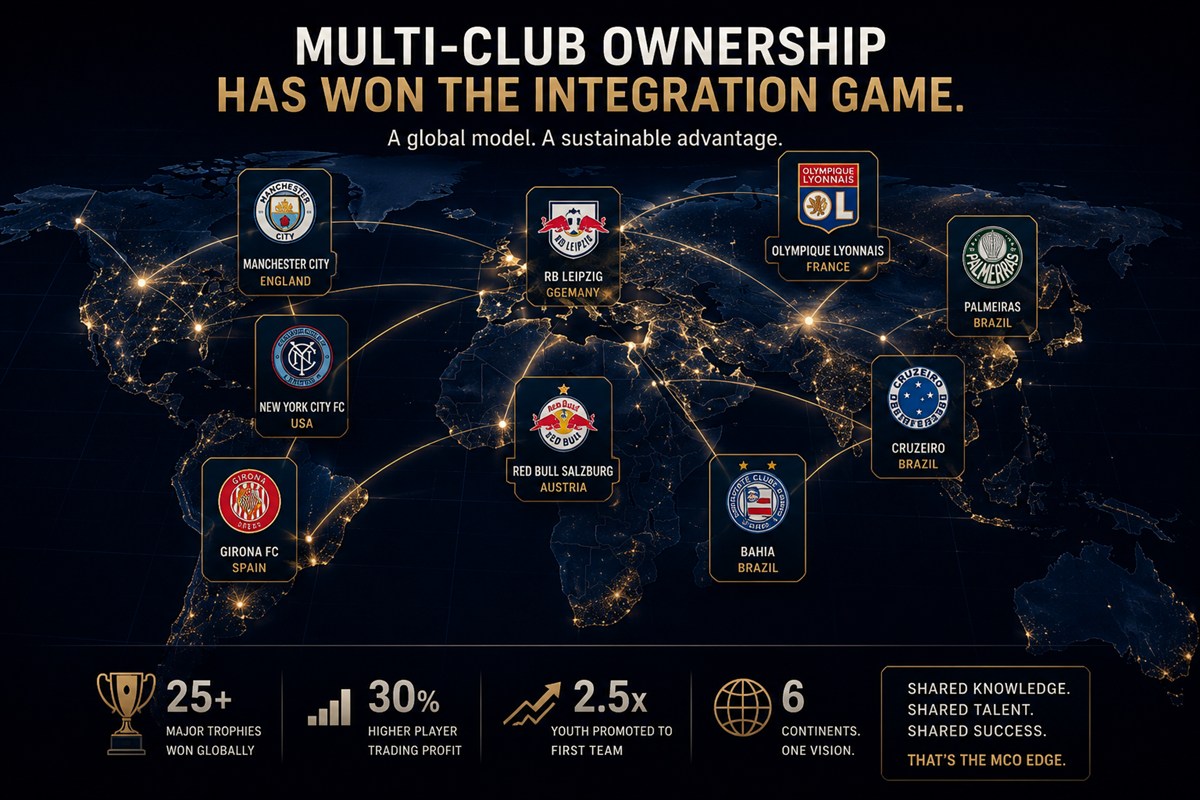
The first decade of the multi-club era was the acquisition phase. Capital deployed quickly, portfolios assembled at speed, and the assumption was that operating value would follow ownership. City Football Group reached thirteen clubs across five continents; Red Bull built five clubs around a tightly engineered talent ladder; RedBird, BlueCo, FSG, INEOS, Eagle, and a long list of smaller groups acquired aggressively through the early 2020s. The market spoke as one: the future of ambitious football capital is multi-club. By 2025–26, the assumption that MCO is the structural answer is the consensus position.
What integration looks like in practice — when it works — is visible at two groups. CFG runs shared analytics, group-wide commercial functions, and a recruitment infrastructure that demonstrably moves players inside the portfolio. Red Bull has an integrated talent ladder visible in audited transfer flows and competitive outcomes across Salzburg, Leipzig, and the satellite operations. These are not abstract synergies. They are operating capabilities that show up in audited accounts and in the visible movement of players, staff, and revenue between the group's clubs. They took roughly a decade to build at each group. They are the reference standard for what integration means.
For the remaining MCO groups — RedBird, BlueCo, FSG, INEOS, Eagle, and the long tail beyond them — the public record does not yet show comparable operating capability. Most disclose limited shared infrastructure beyond scouting databases. Operating accounts at the group level — where consolidated synergies would show up — are typically not published, because the mid-tier groups are private. What the disclosure gap means — whether the operating capability is being built behind closed doors and will reveal itself, or whether it is not being built — is the question the next operating cycle will answer.
Where integration has been pushed visibly and at pace, the operational tension has surfaced quickly. BlueCo has moved at least twelve players between Chelsea and Strasbourg since acquiring Strasbourg in 2023 — most on loan, several on permanent transfers, alongside the appointment of Chelsea's Liam Rosenior as Strasbourg head coach and the broader integration of coaching and recruitment functions. Strasbourg's president has publicly denied that the club is a feeder for Chelsea; the trajectory of player movement, coaching appointments, and squad-building under BlueCo has nevertheless drawn pushback from Strasbourg supporters, who read the pattern as a loss of sporting independence — the club's recruitment and team-building serving the group's broader portfolio rather than Strasbourg's own ambition. The case is a live demonstration of the integration challenge: the operational moves the integration thesis requires are exactly the moves that surface fan and stakeholder resistance when one club's identity as an independent institution appears to be in question. The integrators of the next decade will be defined as much by how they navigate that tension as by whether they build the operating capability in the first place.
03 The regulator narrows the path
Compounding the operating challenge, the regulator is making the model harder to run. Despite the trend toward MCO assembly, UEFA has not accommodated it; if anything, it has hardened against it. Article 5 prohibits any owner from holding decisive influence over more than one club in the same European competition in the same season. For most of the past decade, the rule was a soft constraint — workable through blind trusts, governance carve-outs, and structured separations. In 2025 it hardened. The Court of Arbitration for Sport upheld every UEFA challenge brought against multi-club groups in the cycle; the 1 March assessment date became strict and absolute; and the December 2025 CFCB Circular confirmed no future loosening.
The Manchester City–Girona case is the clearest test. When both clubs qualified for the 2024–25 Champions League, City Football Group was forced to place Girona under an independent blind-trust structure to satisfy UEFA's ownership-separation requirements — preventing the cross-club coordination on personnel, sporting decisions, and transactions that the integration thesis relies on. The model has not been outlawed. It has been made more expensive to run — and the cost falls on every MCO group, including the two that have built integration capability and the many that have not yet shown they are building it.
04 The contrarian read
The consensus on multi-club ownership is straightforward: it is the future of football, the model that generates the synergies a single club cannot, and the structure that justifies the valuations capital is now paying for it.
The counter to that consensus is two-fold. First, the argument that MCO is the future of football is — as of today — premature. With the exception of two groups, most assemblers have not yet shown the value that integration is supposed to extract; and integration, when it works, typically takes a decade or longer to compound into something audited results will reveal. Judging the model on three-to-five-year-old portfolios is the equivalent of pricing a venture portfolio in year three of a fifteen-year fund. Second, the assemblers are not yet heading in the direction that would close the gap. Group-HQ headcount, cross-club data infrastructure, central commercial teams, unified scouting — these are choices made at year one, not outcomes earned at year ten. On those observable measures, most assemblers are not investing at the rate that would produce integration outcomes, and the regulator's hardening posture raises the operating cost of building toward those outcomes at all.
The sharper read is that the central question is no longer about consolidation and buying more clubs. It is whether the groups already assembled will commit to building integration capability — and whether the regulator's posture lets them. Value in MCO does not come from assembly. It comes from running multiple clubs as one platform, which is a different operational discipline. Whether MCO ultimately delivers the platform premium that the capital tier is paying for, or whether the next operating cycle reveals two real platforms and a long tail of holding companies, is the question the decade will settle.
05 The strategic question
European football's regulator currently treats multi-club ownership as an integrity risk to be policed. Other sports — Formula 1 the clearest example — have shown that integration and multi-team ownership can coexist with the integrity guard, under audited operational separation. The strategic question for the next decade is whether football's governance and regulator change stance, and produce an updated framework that allows MCO integration to deliver value for all parties: the owners, the operators, and the fans.