When the money stops.
Apollo walked away from a $2bn loan to City Football Group in its final stages, the Financial Times reports, before any sanction against Manchester City exists. FIFA has confirmed a three-way race for its presidency, with a two-thirds bar in the first round. RedBird has put AC Milan inside a new entertainment company. England’s top women’s league has turned down gambling sponsors at league level. Juventus has set the terms of a $224m share issue, more than it says it needs this year. And Europe’s smaller clubs have asked the European Commission to examine UEFA’s unpublished agreement with the EFC.
Apollo walked away from a $2bn loan to City Football Group. No sanction has been set yet.
City Football Group, or CFG, owns Manchester City and a network of other clubs. Like most large businesses it borrows, and it repays old loans with new ones. That is called refinancing. It gets harder when a lender cannot judge what the business will earn.
In September an independent commission found that Manchester City had broken the Premier League’s financial rules on 114 of 115 charges. City deny wrongdoing and are appealing. The appeal is due to be heard in December, with a decision expected in 2027, reports say. If City lose, a separate commission sets the sanction, which could range from a fine to a points deduction or expulsion.
On 19 November the FT reported that Apollo Global Management had ended talks on a loan of about $2bn to CFG, after they had reached their final stages. As relayed by Football365 and others:
- The loan would have added liquidity and refinanced existing credit facilities, according to people familiar with the matter.
- The FT links the end of the talks to the commission’s finding, but does not say when they ended. Apollo has not given a reason.
- Neither CFG nor Apollo has commented.
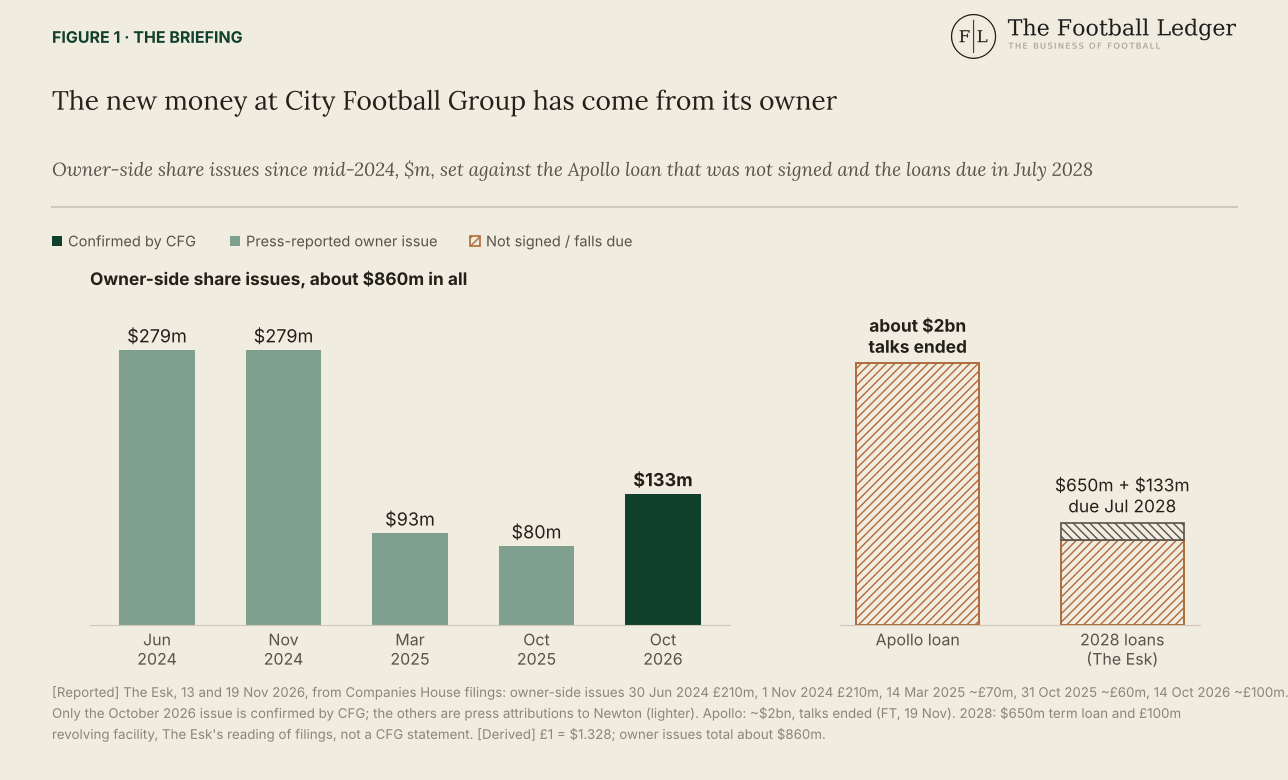
Which loans the money would have replaced is not public. The Esk, an analyst site that reads CFG’s Companies House filings, points to a $650m term loan arranged in July 2021, which falls due in July 2028, and a revolving facility of about $133m from the same group of lenders. That is its reading of the filings, not a CFG statement. On the same analysis, CFG lost about $388m before tax last year on revenue of about $1.18bn.
The new money that has come in is the owner’s. The Briefing of 1 November reported that Sheikh Mansour’s Newton vehicle bought 11.3 million new CFG shares on 14 October for about $133m. CFG’s latest confirmation statement, a filing that lists who owns the shares, shows the result:
- Newton: 81.07%, up from 80.75%.
- Silver Lake, the US private equity firm: 16.16%, down from 16.44%. It has not bought shares since 2022, The Esk says, so each owner issue dilutes it.
The Esk counts about $860m of owner equity since mid-2024 across five issues, most identified from press reports, all at a price that values the group at about $7.9bn. The controlling shareholder set that price. No outside buyer has tested it.
The distinction the story turns on is between borrowed money and the owner’s money. A loan is priced on what the business will earn, and on the FT’s account Apollo would not lend $2bn before the appeal is settled. No replacement lender has been reported, so for now the only new money on record since the finding is Sheikh Mansour’s.
FIFA’s race is set: Infantino, Diallo and Tashima. Winning in the first round takes two-thirds of the vote.
Last week’s Briefing reported that Arsène Wenger would not stand. Nominations closed on 18 November, Ramon Vega failed to get the five a candidate needs, and FIFA has confirmed three candidates for the election in Rabat on 18 March 2027:
- Gianni Infantino, president since 2016, seeking a fourth term to 2031.
- Philippe Diallo, president of the French federation since January 2023, backed by the UEFA member associations on its executive committee and the FIFA Council. England, Germany, Denmark and Belgium have said they back him.
- Kozo Tashima, honorary president of the Japan FA and a member of FIFA’s Council since 2015.
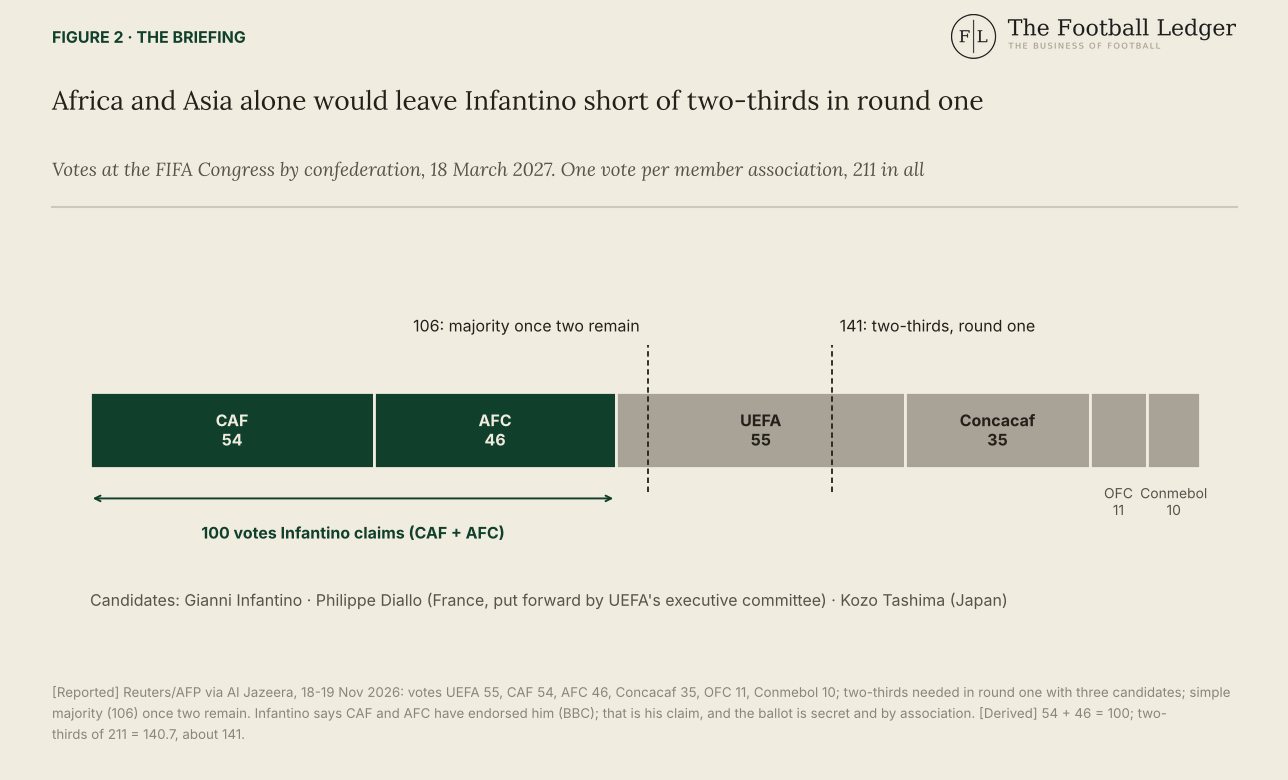
Each of FIFA’s 211 member associations has one vote. With more than two candidates, the first round needs two-thirds, about 141 votes. After that the last-placed candidate drops out each round, and once two remain a simple majority of 106 is enough. The votes by confederation:
- UEFA (Europe): 55.
- CAF (Africa): 54.
- AFC (Asia): 46.
- Concacaf (North and Central America and the Caribbean): 35.
- OFC (Oceania): 11.
- Conmebol (South America): 10.
Infantino says Africa and Asia have endorsed him. That is his claim, and associations vote individually and in secret. If he held both, he would have 100 votes: short of 141, close to 106.
Whether he can stand is also in question. Article 33.2 of FIFA’s statutes says no one may serve more than three terms. In December 2022 the FIFA Council confirmed that his first, shortened term after Sepp Blatter’s resignation does not count. FairSquare, a non-governmental group, told the FA that decision could be challenged in law. The FA’s chair, Debbie Hewitt, replied that a challenge would not succeed. The decision sits with FIFA’s electoral committee, which will tell associations which candidates are admitted by 18 February 2027.
The commercial question has not gone away. FIFA Forward Enterprise (FFE) was the vehicle through which investors would have paid $4.2bn for a permanent stake of more than 20% in FIFA’s commercial business, before FIFA dropped it in July. Bloomberg reported at the time that the plan began in talks with Joshua Kushner, whose firm Thrive was to anchor it, and FIFA did not address how the deal was formed. This week:
- Aleksander Čeferin, UEFA’s president, wrote to FIFA’s secretary general, Mattias Grafström, with European Council members including Hewitt, Bernd Neuendorf of Germany and Sándor Csányi of Hungary. The letter asks which FFE documents Council members can see and why access is restricted, Inside World Football reports.
UEFA’s request to a US court for FFE documents, covered last week, has not yet been granted.
The distinction the story turns on is between who leads FIFA and who controls its commercial business. Infantino’s opponents are trying to make the second the issue of the first. The voting rules decide how much room they have. A first-round win would settle it. A second round would give the challengers a reason to combine, and Tashima has already asked in L’Équipe whether the two should work together.
RedBird has put AC Milan inside a new entertainment company. It has hired the Big 12’s commissioner to run it.
Most football clubs are owned directly: the owner holds the club, and the club holds its players, its brand and sometimes its stadium. A holding company adds a layer. The company holds the club alongside other businesses, so income and value can sit in parts of the group that are not the football club.
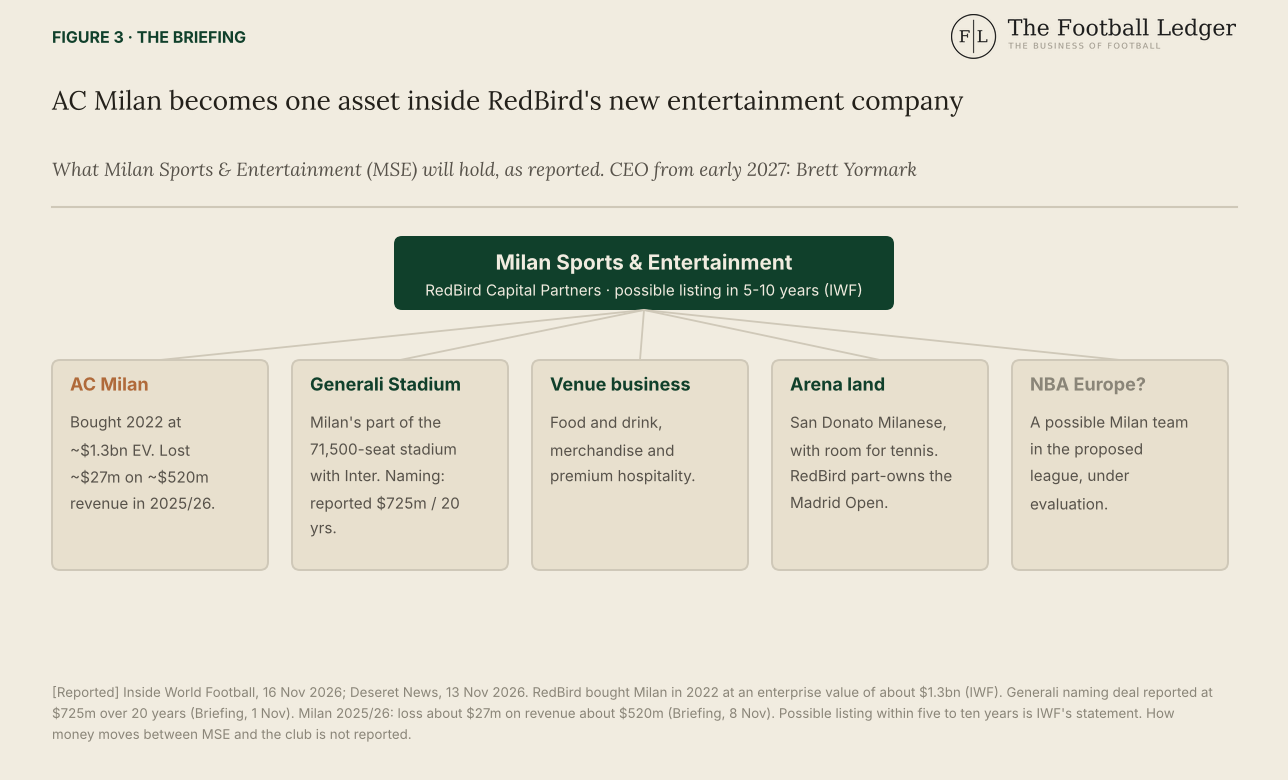
RedBird Capital Partners, which bought Milan in 2022 at an enterprise value of about $1.3bn, has set up Milan Sports & Entertainment (MSE). Inside World Football and the Deseret News report that it will hold:
- AC Milan.
- Milan’s part of the planned 71,500-seat stadium shared with Inter, to be called Generali Stadium. The Briefing of 1 November covered the naming deal, reported at $725m over 20 years.
- A venue-management business it plans to explore, covering food and drink, merchandise and premium hospitality.
- Land bought in San Donato Milanese for an arena, with room for tennis. RedBird part-owns the Madrid Open.
- Possibly a Milan team in the proposed NBA Europe league, which MSE is evaluating.
To run it RedBird has hired Brett Yormark, who leaves the Big 12, a US college sports conference, at the end of January. He ran the Brooklyn Nets’ parent company for 14 years, including a large live-events business, and at the Big 12 he signed a new TV deal and expanded the conference after Texas and Oklahoma left. He has a multi-year deal and is believed to have received equity, Inside World Football reports. He will report to RedBird’s founder, Gerry Cardinale, and oversee the commercial side. Milan will appoint a separate sporting chief to run the football.
RedBird wants an entertainment district around the stadium like L.A. Live in Los Angeles, and Inside World Football says the business could go public within five to ten years.
The football club’s own numbers are thin. The Briefing of 8 November reported that Milan lost about $27m in 2025/26 on revenue of about $520m, after missing European football, and that a new Adidas kit deal reported at about $56m a season starts only in 2028. The stadium is not due to open until 2031/32.
The distinction the story turns on is between building a club and building a company that owns one. The reports do not say how money will move between MSE and AC Milan, for example whether hospitality or arena income will be booked by the club or elsewhere in the group. That matters to anyone who judges Milan by the club’s own accounts.
Women’s leagues are turning down gambling money. In men’s football it has moved down the shirt.
Betting companies have been among football’s biggest sponsors for a decade, and a source close to several deals told Front Office Sports they typically paid about twice what other brands offered. The Briefing of 16 August reported that the Premier League’s ban on betting brands on the front of shirts, which began this season, stopped at the front. Sleeves and training kit were untouched.
The first measurements show what the ban did. As reported by Front Office Sports:
- A University of Bristol study of the opening weekend found the ban removed about 10% of gambling messages. About half of that fall was offset by more shots of sleeves, training kit and LED boards.
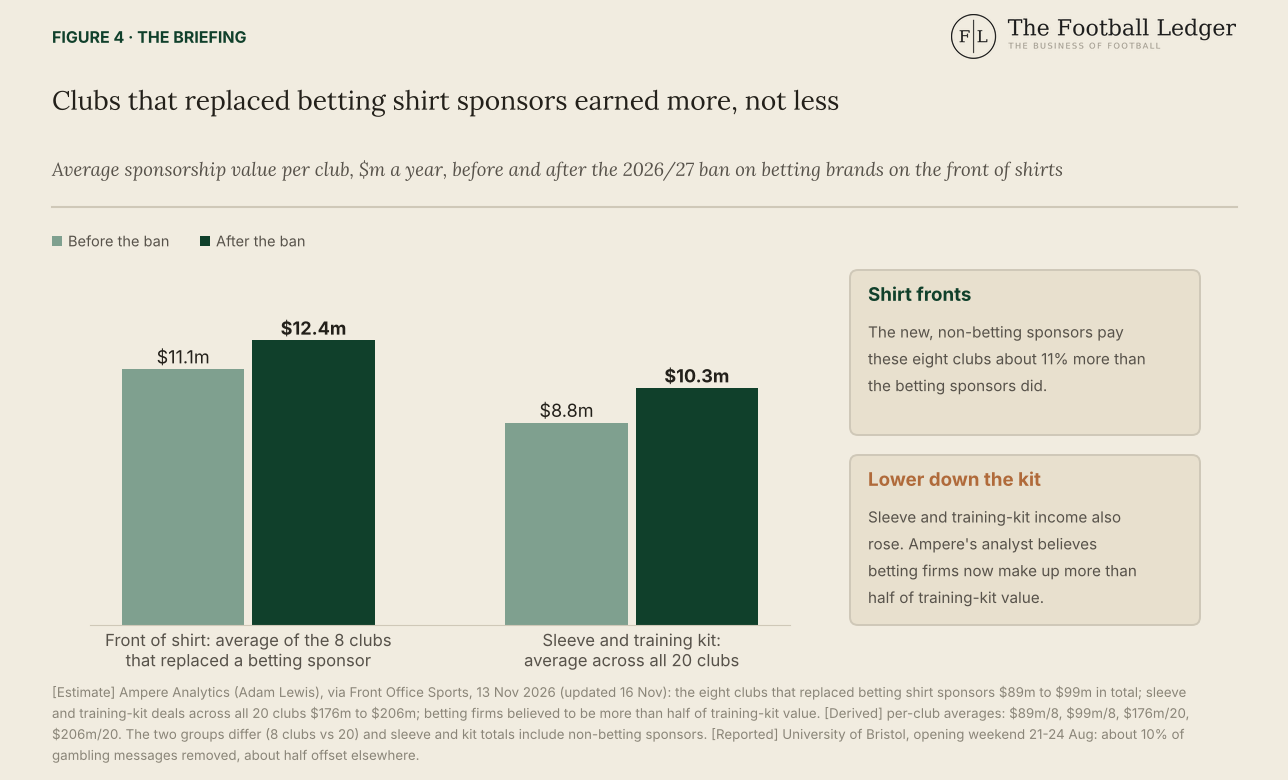
- The eight clubs that had to replace a betting shirt sponsor raised their combined deal value from about $89m to $99m a year, Ampere Analytics estimates.
- Across the league, sleeve and training-kit sponsorships rose from about $176m to $206m a year. Ampere’s analyst believes betting firms now account for more than half of training-kit sponsorship value.
Women’s football is making a different choice at league level. WSL Football, the company that runs England’s top two women’s divisions, has confirmed an unwritten agreement with clubs to keep gambling sponsors out, TheLines reports, and none of its league partners is a betting brand. SBC News says the decision reflects player sentiment towards betting companies. Clubs can still sign their own deals, and Birmingham City and West Ham have betting sponsors carried over from their men’s teams. The league’s partner slots are held by Apple, Airbnb, British Gas, Mercedes, Tesco and WTW, with Barclays as title sponsor.
In the US the same week, the NWSL and the PWHL, the women’s ice hockey league, told Front Office Sports they are not pursuing deals with prediction markets such as Kalshi and Polymarket, which let users trade on the outcome of events. The NBA, NHL, MLB and MLS each have between one and four.
The distinction the story turns on is between keeping gambling money out and moving it somewhere less visible. On Ampere’s estimates, Premier League clubs that replaced betting shirt sponsors earn more than before, and sleeve and training-kit income has also risen. On these estimates the ban moved much of the gambling money rather than removing it. The women’s leagues are giving up a category that pays well, at a stage when they are still trying to grow. Whether that costs them depends on what brands like Apple and Tesco will pay for a league with no betting partner, and none of the reports gives those figures.
Juventus is raising more than it says it needs. Its owner is covering the gap again.
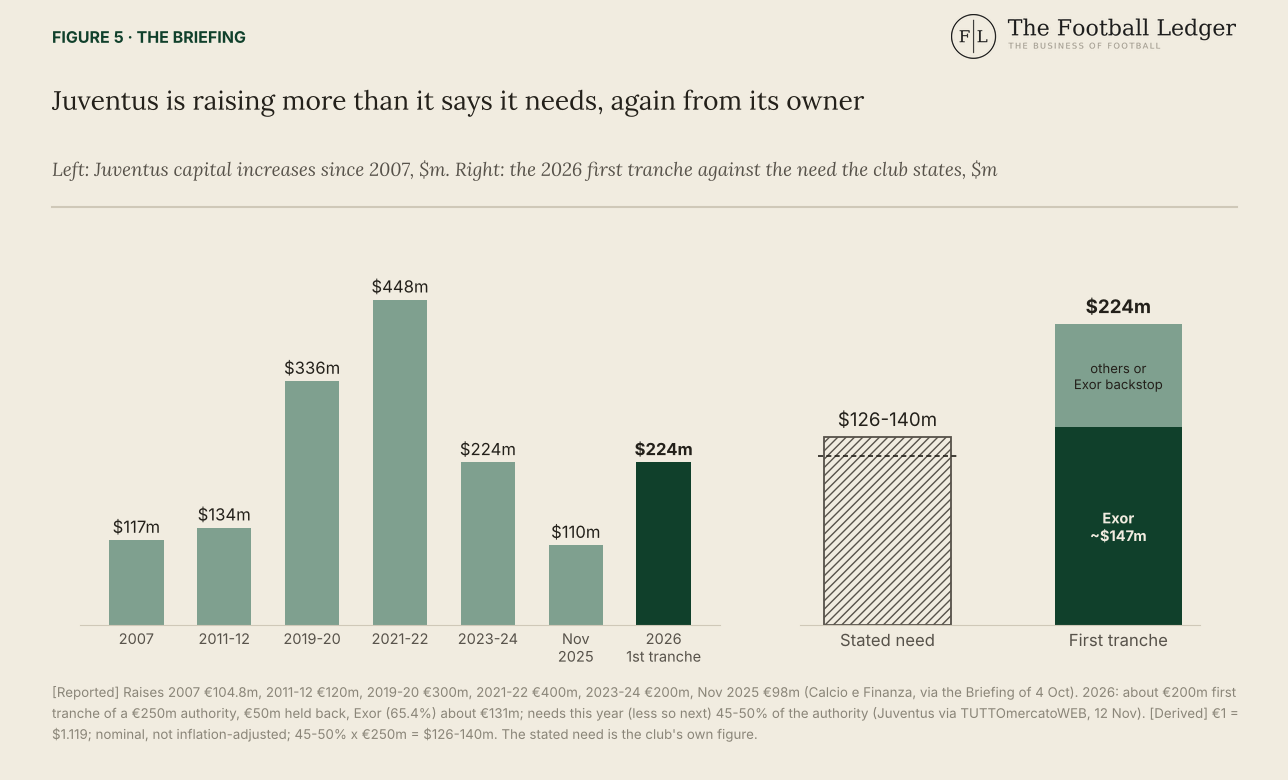
Juventus is listed on the stock exchange. When it runs short of money it holds a capital increase: it issues new shares, existing shareholders are offered them first, and the cash goes to the club. Its controlling shareholder is Exor, the Agnelli family holding company, with 65.4% of the shares. The Briefing of 4 October reported the plan to raise up to $280m, Juventus’s seventh capital increase since 2007, after a loss of about $74m.
The need comes from the pitch. Juventus went out of last season’s Champions League in the knockout play-off, plays in the Europa League this season, and told shareholders it expects another loss this year.
The board has now set the first tranche, TUTTOmercatoWEB reports:
- About $224m, or 80% of what shareholders approved. About $56m is held back for later years.
- One new share for every two held, priced 28% below the expected share price once the new shares exist. Subscriptions close on 1 December.
- Exor takes about $147m, of which $67m is already paid, and will buy any shares other investors leave.
On Juventus’s own figures, its needs for this year, and to a lesser extent next year, are about $126m to $140m. The first tranche is $224m. The club lists other uses for the rest: stronger equity, meeting UEFA and Italian financial rules, possible investment in its facilities, and a buffer against sporting and transfer risks.
Juventus is not the only Italian club with a gap to fill. Calcio e Finanza calculates that Serie A’s $4.52bn of revenue in 2024/25 falls to about $3.36bn without gains on selling players. A club that cannot sell players at a profit has to find the money somewhere else.
The distinction the story turns on is between money the club earns and money its owner puts in. On Calcio e Finanza’s figures, Exor put about $715m into the four raises since 2019 alone, and this tranche adds about $147m more. Each raise has kept Juventus solvent. The accounts have not yet shown a club that pays its own way.
Europe’s smaller clubs have taken UEFA’s deal with the EFC to Brussels. The agreement has never been published.
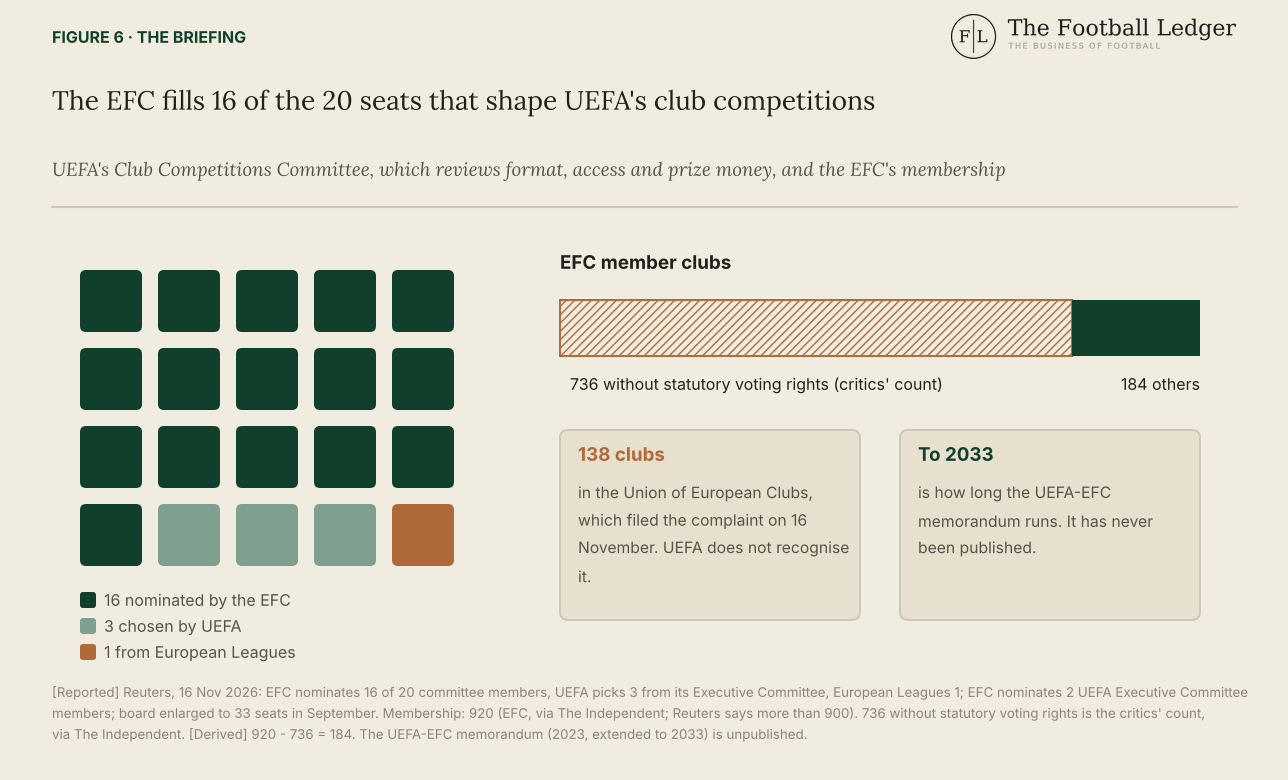
UEFA runs the Champions League, the Europa League and the Conference League, and agrees with the clubs how they are run and how the money is shared. Since 2023 it has done that through a memorandum of understanding with one club body, European Football Clubs (EFC), formerly the European Club Association. The memorandum was extended in 2024 to run to 2033. It has not been published.
What it gives the EFC is known from reporting. Per Reuters and Inside World Football:
- The EFC nominates 16 of the 20 members of UEFA’s Club Competitions Committee, which reviews changes to format, access and prize money. UEFA picks three and the leagues’ body one.
- The EFC nominates two members of UEFA’s Executive Committee.
- The EFC co-owns UC3, the joint venture with UEFA that handles the club competitions’ commercial rights.
- Its chairman is Nasser Al-Khelaifi, president of Paris Saint-Germain.
On 16 November the Union of European Clubs (UEC) filed a complaint with the European Commission. The UEC was founded in 2023 and says it has 138 member clubs, mostly small and mid-sized. It argues that the memorandum breaks Articles 101 and 102 of the EU treaty, which ban anti-competitive agreements and the abuse of a dominant position. It wants the memorandum published, restrictive clauses removed and UEFA’s rules changed, The Independent reports.
The argument turns on who has a vote. The EFC says it has more than 900 member clubs. Critics cited by The Independent say 736 of them have no statutory voting rights. In September the EFC enlarged its board to 33 seats, five to seven of them reserved for member-club representatives, Reuters reports, and the EFC says all members now vote for the board. A study reported by POLITICO finds that about 50 clubs have taken about four in five Champions League places since 2000.
The complaint leans on the Court of Justice’s Super League ruling of December 2023, which found that UEFA holds a dominant position and that its rules on access must be transparent, objective and non-discriminatory. That case was brought by clubs that wanted to leave UEFA’s system. This one is brought by clubs that want more say inside it.
UEFA, which does not recognise the UEC, said it would cooperate fully with the Commission, The Independent reports. Sources at the EFC called the complaint an attempt at disruption. The Commission has not said whether it will open a case. A complaint is a request to investigate, not a finding.
The distinction the story turns on is between representation and control. The EFC speaks for more clubs than ever, but the clubs with votes fill the seats that shape the format and prize money every club lives with. If the Commission investigates, it starts with a document no outsider has read.