Rio Ferdinand gave up his TV seat. His audience came with him.
The accepted rule in punditry is that the TV seat comes first. Gary Neville built his own media company without giving up his Sky seat. Rio Ferdinand broke the rule. In 2025 he left TNT Sports for the channel he had spent sixteen years building, and the audience followed him. The open question is how far his companies can go, and whether anyone will ever pay for them.
 Written by Anthony Raad
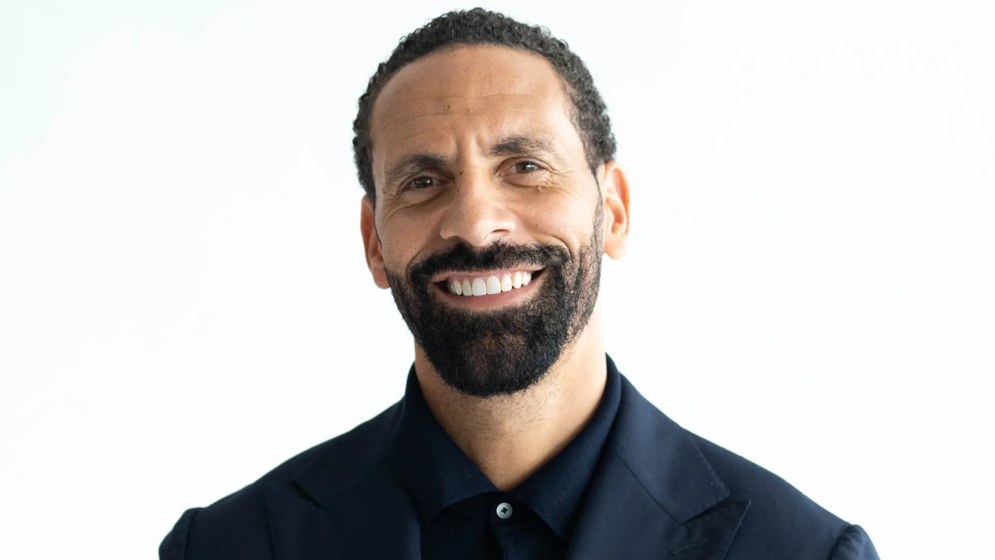
On 28 May 2025, Rio Ferdinand announced he was leaving TNT Sports. He had been with the broadcaster since 2013, when it was still BT Sport, and he signed off at the Champions League final in Munich three days later. By his own account, he was not pushed. "I could have signed a new contract at TNT easily," he told Men's Health in February 2026. The broadcaster, he said, "weren't really as receptive as I would've liked" to what he wanted next, and if a partner would not "jump in two-footed" with him, "then I move on." He had no other TV deal lined up. He said he would focus on his YouTube channel and podcast, Rio Ferdinand Presents, and his businesses. A pundit can walk away from a top broadcaster on those terms only if he has an audience of his own to walk to. Ferdinand had spent sixteen years building one.
01 An audience of his own
In April 2009, Ferdinand was 30 and still Manchester United's first-choice centre-back. That month he launched #5, a digital magazine named after his shirt number. The usual route for a star player was a newspaper column, which builds the paper's audience, not the player's. #5 worked the other way. It was published by Made Up Media under licence from New Era, Ferdinand's own management company, so the brand stayed with him. Marketing Week reported at launch that Nike had already signed up as an advertiser, and the publisher's managing director, Danny Crouch, said Ferdinand had "gravitas with the advertising community."
The magazine became FIVE, a football channel with Ferdinand as editor-in-chief, and later Rio Ferdinand Presents. By August 2022, when it joined the podcast network Acast, it had more than 800,000 YouTube subscribers and 170 million video views. Television ran alongside it. He joined BT Sport in 2013 and retired as a player in 2015. For a decade he had both: the broadcaster supplied a salary and the biggest stage, and the channel was the part he kept.
02 Why owning it matters
The difference between the two is simple. A pundit on television rents the broadcaster's audience: he is paid a fee each season, and the shows and the viewers stay with the channel when he leaves. A pundit with his own channel owns his audience. His interviews, including one with Cristiano Ronaldo, sit on a channel his company controls, and those viewers stay with him when a contract ends.
Owning the audience changes what he can ask for. He can put money into other businesses on the strength of his name, and deal with broadcasters as a supplier rather than an employee. His moves since 2024 show both.
- Equity. In December 2024 his investment company, The Ferdinand Group, took a minority stake in Koora Break, a Saudi football app, in what Koora Break called a "multi-million-dollar deal." Ferdinand tied the app's growth to the 2034 World Cup in Saudi Arabia.
- A route to the US. In March 2025, New Era agreed a partnership with WME, the Hollywood talent agency, which was reported to be seeking roles at the 2026 World Cup for its clients.
None of these needed a weekly seat in a London studio. Each needed a name and an audience that would travel with him. Leaving TNT put that to the test.
03 Is the channel better off without TV?
Most of his peers would have said no. In punditry the TV seat comes first. Thierry Henry has made CBS's Champions League studio his main stage. The pundits who build their own channels do it alongside the seat, not instead of it: Neville has kept his Sky contract through every stage of The Overlap, and Carragher works for Sky and for CBS while appearing on Stick to Football. The broadcaster supplies the reach and the channel supplies the ownership. Give up the seat, the thinking goes, and the audience shrinks with it.
Ferdinand gave it up, and the audience grew. The channel had about 1.2 million subscribers in December 2024 and 1.32 million when he announced his exit. By December 2025, The Athletic reported more than 1.5 million: at least 180,000 new subscribers in the months after he left, against roughly 120,000 in the months before.
The exit alone did not cause that growth. The channel was already speeding up, and the months after he left carried the publicity of the exit itself and ended with the World Cup draw. But the shrinking audience his peers would have predicted never came. Without a seat, the channel kept growing at least as fast as it had with one.
Television did not disappear either. It came back on his terms. On 5 December 2025 he conducted FIFA's World Cup draw in Washington. In June 2026 Fox put him in the studio for its nightly World Cup after-show with James Corden, after The Athletic had reported talks about an analyst role. Both were bookings for one tournament. He was no longer a broadcaster's employee; he was a name it hired.
So far, the channel is better off without the TV seat. Once a pundit owns his audience, the seat becomes optional and the broadcaster becomes a customer.
That answers the question for the channel. It does not yet answer it for the man.
04 Is Rio better off?
By his own account, yes. Asked on the Long Play podcast when he earned the most, he said "probably the last few years," a period that runs through his TNT exit and starts long after his peak at Manchester United. His deals point the same way. He now invests, not just earns fees: on top of the Koora Break stake, he was an early backer of Sokin, the London payments firm valued at $300m in December 2025.
The room to grow is larger than the channel. When he invested in Koora Break he had 1.2 million YouTube subscribers, 6.5 million Instagram followers and 11.5 million on X. The audience he owns is the smallest one he has. The other 18 million follows are not 18 million separate people, since many fans follow him in more than one place. But they are an audience that already knows him and has not yet come to the channel.
What cannot be shown yet is the money. His main UK company, R.G.F. Enterprises, reported net assets of about £2.3m at March 2025, down 6.7 per cent on the year, and as a small company it publishes no revenue. His stakes in Koora Break and Sokin have never been disclosed. And everything still runs on his face: the channel has had regular co-hosts since 2022, but he fronts the shows and the biggest interviews are his.
So the answer is yes on audience and on opportunity, and unproven on value. Proving it would take the thing Neville already has: a company that someone else has put a price on.
05 How far can it go?
Neville shows what that looks like. The Overlap began as Neville interviewing players on his own channel. In 2023 it added Stick to Football, a round-table with Carragher, Roy Keane, Ian Wright and Jill Scott, and that show became its engine. In January 2026 Global, the radio group behind LBC and Capital, bought a majority of the company, and the business went on to buy Mark Goldbridge's Manchester United channels. Global bought a network that did not depend on one face.
Ferdinand has the audience without the company. Rio Ferdinand Presents is about the size The Overlap's main channel was when Global bought in, around 1.5 million subscribers against 1.6 million. But no outside investor in it has been reported, and he fronts its shows. His stakes sit in other people's businesses. The 2026-27 season, the first since he left TNT with no World Cup behind him, will show what the channel holds on its own.
Two questions remain. How far can Ferdinand's companies go: will a new company emerge from the channel and his stakes, with shows and products that do not need his face? And will Rio Ferdinand Presents reach the point where a buyer puts a price on it, as Global did for Neville? Until one of those happens, he has proved the audience is his, but not that it is a company.