Michele Kang
The Korean-American businesswoman deploying an investment model that is oriented towards ensuring an economically prosperous future for women’s football whilst solidifying women’s football as a cornerstone in football culture.
 Written by Marcus Puhalj
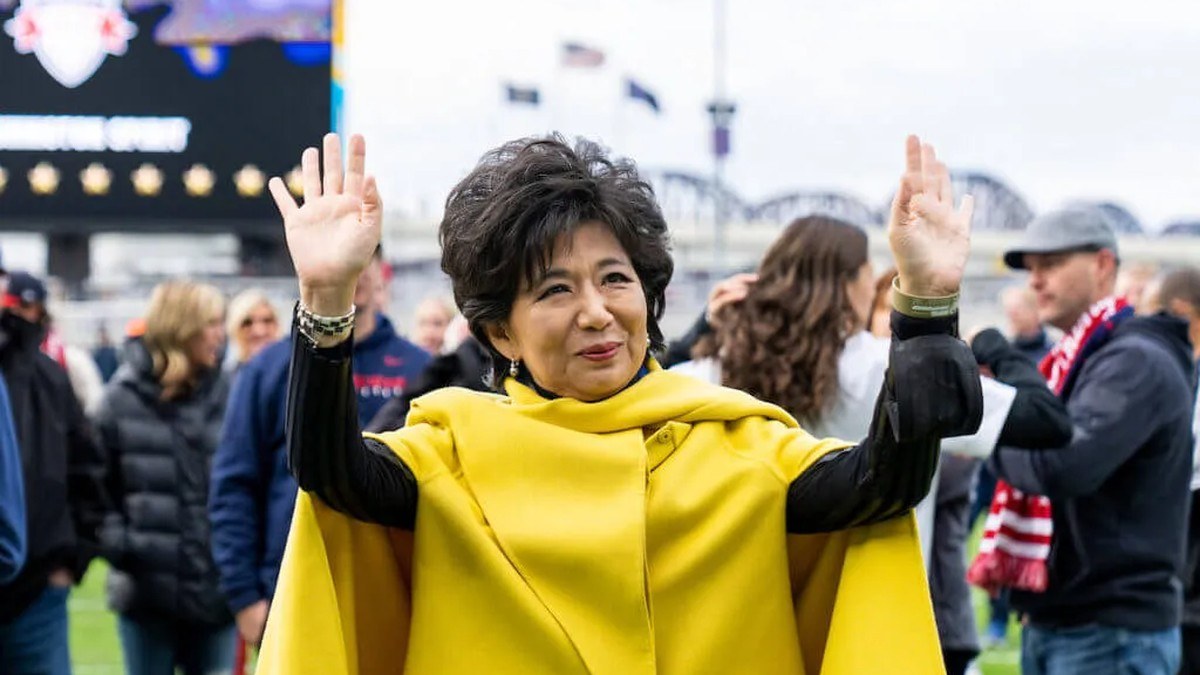
01 Michele Kang: A Welcome Visionary Behind Women’s Football
Since its professional emergence a few decades ago, women's football has operated as an industry that often struggled to find the resources, infrastructure, and commercial recognition afforded to its male counterpart. Yet as audiences grow and the sport continues to establish itself within global football culture, a new generation of investors is beginning to recognise the serious opportunities in women’s football that have long been overlooked. Among the most prominent of these investors is Michele Kang, the South Korean-born American businesswoman whose growing involvement in women's football is challenging the traditional economics of the sport.
Having built her business career in healthcare technology, Kang has increasingly directed her efforts and business prowess towards growing women’s football. She joined the Washington Spirit's ownership group in 2020 and became its majority owner in 2022, before acquiring control of OL Lyonnes (formerly Olympique Lyonnais Féminin) and the London City Lionesses. Her ambitions, however, extend beyond the individual fortunes of these clubs. Through Kynisca, her dedicated women's sports organisation, she is attempting to establish a more connected and professionally developed football ecosystem.
What distinguishes Kang is not simply the scale of her financial commitment, but the philosophy underpinning it. Rather than treating women's football as an extension of an established men's operation, she sees an opportunity to build something commercially and culturally significant in its own right. That distinction holds even though, in June 2026, she also agreed to take control of Olympique Lyonnais's men's club: OL Lyonnes remains a separate company within Kynisca. The question is whether her approach can help turn the growing popularity of women's football into an economically sustainable industry, while establishing the professional foundations necessary for its continued development.
02 Investing for a sustainable future
One of the most significant obstacles to the development of women's football has been its historical position within the wider football business. For many clubs, the women's team has existed as an additional responsibility attached to an established men's operation, often competing for attention, resources, and institutional priority. While this arrangement has provided certain financial and infrastructural advantages, it has also contributed to an environment in which the women's game can struggle to reach its full potential by establishing its own identity and commercial direction. Kang's investment philosophy challenges this arrangement. Her approach suggests that women's football should not have to depend on the priorities or financial performance of a men's team to justify its existence. Instead, she is investing in the proposition that a women's club can become a valuable sporting and commercial enterprise when given the attention and organisational commitment required to develop independently.
The distinction is particularly interesting when considering the different ownership structures across women's football. In the United States, independent clubs make up more than 2/3 of the league and are an established feature of the National Women's Soccer League. Whereas in England, 2/26 of the professional women’s teams from the first and second division are independent clubs, meaning the historical relationship between men's and women's clubs remains considerably more prevalent. Independence does not automatically guarantee success, nor does affiliation necessarily prevent it. However, the ability to establish a distinct identity, attract direct investment, and develop commercial relationships around the women's team presents an important opportunity.
London City Lionesses offer perhaps the clearest illustration of Kang's approach to this problem. Rather than partnering with an existing men's football club and developing its women's department, she became owner and invested in a club whose identity and ambitions were already rooted exclusively in the women's game. Its subsequent promotion to the Women's Super League (England's top flight) created an opportunity to test whether an independently operated club could compete at the highest domestic level while establishing its own commercial proposition. That proposition received a significant endorsement in September 2026, when London City announced a landmark partnership with Nike. The agreement combines front-of-shirt sponsorship with a technical partnership, representing a particularly important development for a club that is attempting to establish itself without the traditional backing of a men's team. Its financial terms have not been publicly disclosed, but Kang has indicated that the front-of-shirt agreement “is higher than some of the men's Premier League front of shirt deals." More importantly, her interpretation of the agreement reveals the investment philosophy behind the project: "they did not write a charity cheque they believe in the future, and they believe together we will invest and build the future together."
The distinction between sponsorships which act strictly as a source of financial assistance and a sponsorship which doubles as a source of capital as well as a commercial partnership is fundamental. Nike is not simply providing support to a developing football club; it is associating its brand with an organisation it believes has the potential to grow. That confidence offers a powerful example of what can happen when women's football is presented as a genuine commercial opportunity rather than an obligation attached to the men's game. Kang's wider ambition is to establish an environment in which independent women's clubs can attract investment, develop their own audiences, and build commercial relationships that reflect their actual potential. Her approach does not suggest that independence is the only viable ownership structure, but it does challenge investors and existing football institutions to reconsider how much prospective value they have historically overlooked.
03 Kynisca: Establishing an Ecosystem
If Kang's ownership of individual clubs demonstrates her confidence in women's football, Kynisca provides the organisational framework through which she intends to expand that influence. Established in 2024, the organisation represents a departure from the conventional multi-club ownership model, in which investors often seek to establish connections between teams to improve recruitment, player development, and sporting operations. Kang's ambition is to create a structure specifically designed around the requirements of women's football. Its portfolio brings together three clubs operating within different football environments: the Washington Spirit in the United States, OL Lyonnes in France, and the London City Lionesses in England. Although each club has its own infrastructure and identity, their connection enables the possibility to share expertise and resources across national boundaries.
The main benefits of this model lie in the sharing of performance science, medical support, recruitment networks, data analytics, and professional development teams as they can be deployed across the organisation, potentially improving the quality of each club while also reducing certain operational costs.
Kynisca's philosophy towards improving women’s football is built around the "belief that reaching its full potential [will require] sustained investment, world-class environments, and an uncompromising commitment to excellence." And this ambition extends beyond three football teams. It reflects their ambition to develop a culture and infrastructure to support women's football that has historically been lacking.
This model also provides a broader commercial opportunity for the respective clubs. Operating across three major football markets allows Kynisca to engage with different audiences, sponsors, and commercial partners, while developing a recognisable identity associated specifically with women's sport. Rather than relying on the global reach of an existing men's football brand, the organisation has the opportunity to establish its own position within the expanding women's sports industry. Of course, a multi-club structure is not without its complications. Different leagues operate under different regulations, and each club must maintain its own sporting identity and relationship with its supporters. Centralising too much decision-making could undermine the very independence that makes these clubs so valuable to their communities in the first place. Nevertheless, the underlying idea is significant. Women's football does not necessarily need to reproduce the business structures of men's football to achieve commercial success. Kynisca is an attempt to demonstrate that a dedicated organisation, built around the specific needs of the women's game, can provide an alternative route towards achieving long-term value and professionalism.
04 Investing in the Talent Pipeline
Naturally, the commercial development of women's football is heavily dependent on the quality of the football and footballers on display. Stronger broadcasting agreements, more lucrative sponsorships, and larger audiences can increase the resources available to clubs, but none of these developments can be sustained without players who have professional environments providing them the platform to perform at the highest level. For Kang, investment in women's football therefore extends well beyond the acquisition of a few clubs.
Her commitment to U.S. Soccer provides one of the clearest examples. In November 2024, Kang pledged $30 million over five years towards the development of girls' and women's football in the United States. The funding was intended to expand competitive opportunities, improve talent identification, and support the professional development of female players, coaches, and referees. In April 2025, she committed a further $25 million through a partnership integrating Kynisca's Innovation Hub into U.S. Soccer's, Soccer Forward Foundation. Together, these commitments represented $55 million directed towards strengthening the foundations of the American women's game. The importance of this investment becomes clearer when considering the structures that have historically supported women's football in the United States. Title IX, introduced in 1972, prohibited sex-based discrimination in federally funded education programmes, helping establish a framework through which girls and women could access sporting opportunities at an equal rate to their male counterparts. Its influence on American sport has been considerable, contributing to the development of a much broader female participation base. However, it is important to recognise that Title IX is not simply a requirement to divide every sporting budget equally between boys and girls. Rather, it establishes broader obligations around equal opportunity in educational institutions. The resulting sporting culture has helped the United States develop an extensive pool of female footballing talent, contributing to the country's longstanding international competitiveness. Despite this bright spot, participation opportunities alone cannot guarantee that every player will receive the professional support necessary to reach her potential. This is where Kang's investment becomes particularly relevant. If other countries wish to close the historical gap between their boys' and girls' development pathways, stronger institutional support must be accompanied by dedicated financial commitments.
The next step in equalising those opportunities is to ensure that the next generation of female players does not encounter the same limitations that have affected previous generations. This means developing qualified coaching networks, professional medical support, suitable training facilities, competitive environments and research that accounts for the specific requirements of female athletes. Kang's work through the Innovation Hub reflects this ambition. By directing resources towards female-specific performance research, she is helping address an area in which the professional game has historically lacked sufficient attention. Better understanding of female physiology and specific training requirements can contribute to more informed approaches to player development and performance management. The economic implications are equally important. A football industry that consistently underinvests in its players is limiting the quality and value of its own product. Developing infrastructure to support stronger talent pathways will improve the standard of professional football and provide future generations with a more realistic opportunity to pursue the sport as a career. It can also help ensure that the financial growth occurring at the elite level reaches further down the development structure.
Ultimately, Kang is attempting to put an end to the treatment of women's football as an underappreciated asset. The objective is not simply to provide female players with resources comparable to those available to men, but to establish an environment in which their development is treated as an investment in the future value of the sport as a whole.
05 Kang’s Legacy
The ultimate measure of Kang's influence will not be a simple analysis of how well her clubs performed under her ownership, but whether her investments helped establish a more sustainable economic foundation for women's football by providing a template of how to go about ownership and investments. The challenge facing the industry is to convert growing public interest into a lasting positive feedback loop among supporters, broadcasters, and commercial partners. Without that transition, increased attention risks becoming a temporary opportunity rather than the beginning of a self-sustaining business. The commercial potential is increasingly difficult to dismiss. Deloitte projected that global revenues across elite women's sport would reach at least $3 billion in 2026, demonstrating the scale of the wider market developing around female athletes and competitions. Yet the opportunity is not distributed equally, and individual clubs still need to establish the infrastructure and commercial operations in order to capture their share of that growth. London City Lionesses provide an interesting case study. Their progression into the Women's Super League, ambitious sporting recruitment and landmark Nike partnership demonstrate how an independently operated women's club can go about building its own identity and commercial appeal. The next challenge is converting that ambition into a larger, loyal supporter base and recurring revenue capable of supporting its sporting expenditure over the long term.
This is where Kang's example could prove particularly influential. Other investors should note that women's football does not simply need financial assistance; it needs investors prepared to get involved in the industry by committing capital over an extended period and developing the structures through which that investment can generate lasting value. Kang's ambition can perhaps be best understood through her own assessment of the inequalities that continue to exist within the sport:
"The gap between the boys' and girls' [professional] journeys is indefensible, and I want that to disappear."
For women's football to reach its full potential, that ambition must extend well beyond one investor. If others are prepared to follow her lead, the sport can begin to move away from a model dependent on individual acts of financial support and towards an industry capable of sustaining its own growth. Kang may not single-handedly determine the future of women's football, but she is certainly demonstrating what that future could look like. And perhaps her greatest contribution will be inspiring others to operate as she has.