Khaldoon Al Mubarak built Abu Dhabi's football empire. Now it faces its biggest test.
Chairman of Manchester City and City Football Group, and chief executive of Mubadala: Khaldoon Al Mubarak is Abu Dhabi's link to the football world. The verdict against City now tests the network he built.
 Written by Marcus Puhalj
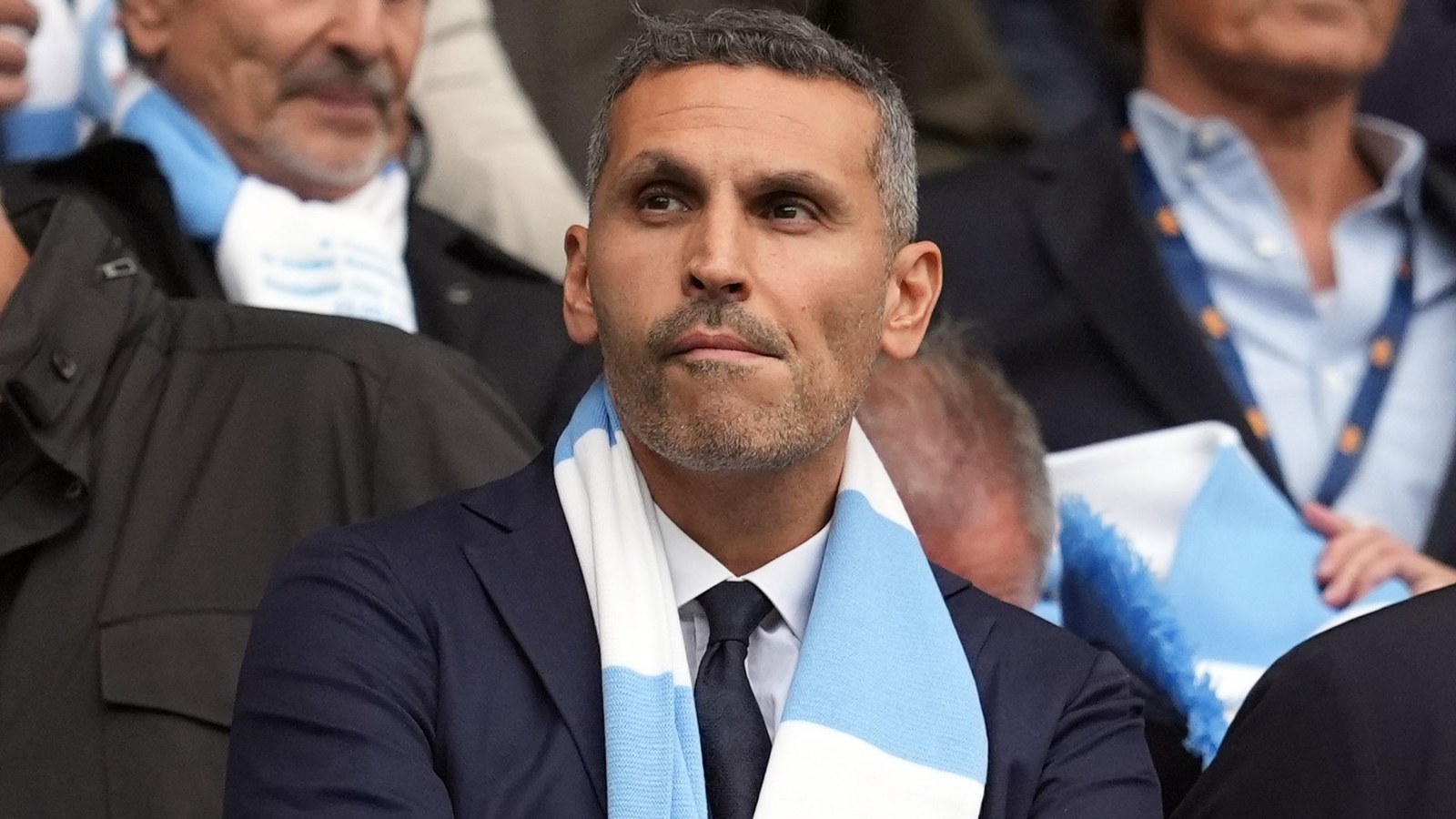
01 Who is Khaldoon Al Mubarak, what does he represent, and what does he work towards?
Football has become a vehicle through which some of the world's wealthiest nations extend their commercial and international influence. Few individuals embody this transformation more comprehensively than Khaldoon Al Mubarak. Having chaired Manchester City since Sheikh Mansour bin Zayed Al Nahyan’s acquisition of the club in 2008, Khaldoon has overseen its evolution from an ambitious sporting investment into the flagship asset of a multinational football enterprise. That being said, managing football clubs around the world (including Manchester City) makes up only a fraction of his professional responsibilities. As managing director and group CEO of Mubadala, Abu Dhabi’s $385 billion sovereign investment company, and chairman of the emirate’s Executive Affairs Authority, Khaldoon occupies a position of considerable importance within Abu Dhabi’s economic and political establishment. His responsibilities extend across industries that are instrumental to the emirate’s transition towards a less oil-dependent economy.
Despite occupying such highly sought after managerial roles at multiple Abu Dhabi based economic and political establishments, Mubadala is not a publicly identified shareholder in Manchester City or City Football Group (CFG), nor is there established evidence of direct financial contributions from the sovereign fund towards either entity. Their connection is best understood through Khaldoon himself and the investment philosophies that underpin both organisations. His significance to the football industry consequently extends beyond the City Football Group and Manchester City’s sporting achievements. Through Khaldoon, football offers a particularly revealing perspective on how Abu Dhabi converts financial wealth into international commercial presence, institutional relationships, and influence.
02 City Football Group: international reach
When Abu Dhabi United Group (ADUG), Sheikh Mansour’s investment vehicle, acquired Manchester City in 2008, the immediate objective was to establish the club among European football’s elite. What subsequently emerged under Khaldoon’s chairmanship was considerably more ambitious: an ownership structure designed to capture value across the global football industry rather than within one club alone. The establishment of City Football Group in 2013 marked the formalisation of that ambition. Its expansion began with the creation of New York City FC that same year, followed by the acquisition of Melbourne Heart in Australia who were subsequently renamed Melbourne City in 2014. Investments in Uruguay and Spain followed in 2017 through Montevideo City Torque and Girona. Further expansion into markets including China, Belgium, France, Italy and Brazil transformed CFG into an international football enterprise. Although Khaldoon provided strategic oversight as founding chairman, executives such as Ferran Soriano were instrumental in translating that vision into an operational business model.
CFG did not invent the multi-club ownership model. Its contribution to multi-club ownership was to develop the concept into an integrated commercial ecosystem of unprecedented geographical ambition. Traditionally, a football club’s ability to generate value is constrained by its domestic market, competition revenues and sporting performance. Multi-club ownership broadens those parameters. A player identified in South America can be developed within the network before entering a more lucrative European market. Scouting infrastructure, performance analytics, and operational expertise can be distributed across multiple clubs, increasing the potential return on investments that might otherwise benefit only one organisation. Commercial partners and technical sponsors, meanwhile, gain access to audiences across several continents through a single business relationship. For Abu Dhabi, the implications extend beyond football’s immediate revenue streams. Rather than concentrating capital and international exposure within Manchester, CFG establishes commercial footholds in economies with fundamentally different consumer markets, sporting cultures and growth trajectories. Football becomes a form of geographical diversification, albeit within a single industry, while simultaneously providing access to local business communities and institutional networks.
The significance of external investment should not be overlooked either. In 2019, American technology investment firm Silver Lake entered CFG’s ownership structure through a $500 million investment, valuing the group at $4.8 billion. Silver Lake has since increased its stake to approximately 17%, while Sheikh Mansour retains majority ownership through Newton Investment and Development LLC. The transaction demonstrated that an enterprise initially financed by Abu Dhabi capital could attract substantial independent institutional investment. Khaldoon’s importance lies in his ability to oversee this transition from concentrated ownership capital towards an internationally investable business. His experience outside football, and his personal links to the United States, make the evolution particularly compelling: CFG increasingly resembles a portfolio-based investment enterprise rather than a conventional collection of football clubs.
Manchester City remains its most valuable sporting and commercial asset. But the achievement of CFG, from Abu Dhabi’s perspective, is that its international presence no longer begins and ends in Manchester. Football has become an infrastructure through which commercial relationships, capital, and influence can travel between markets.
03 Mubadala: a parallel investment philosophy
To understand Khaldoon’s approach to football ownership, it is worth examining the institution that has defined much of his professional career.
Mubadala is a state-owned global investment firm that manages approximately $385 billion in assets, with investments spanning more than 80 countries. Its mandate combines long-term financial returns with the development and diversification of Abu Dhabi’s economy. Through investments in industries ranging from semiconductors and artificial intelligence to healthcare and infrastructure, Mubadala seeks to establish sources of economic value that extend beyond the emirate’s famed hydrocarbon wealth.
Khaldoon provides a particularly significant institutional connection between Mubadala and CFG. That relationship is reinforced by Sheikh Mansour, who chairs Mubadala’s board while retaining majority ownership of CFG through his own investment company. The organisations nevertheless operate under different ownership structures and investment mandates. Their parallels don’t lie in financial interdependence, but in their approach to deploying capital: establishing international positions, developing commercially valuable relationships, and pursuing growth across multiple markets.
Whether these activities can remain insulated from one another has recently become a question of practical importance. Speaking at the Bloomberg New Economy Forum in October 2026, Mubadala deputy group CEO Waleed Al Muhairi maintained that Manchester City’s financial-rule verdict would not alter the sovereign fund’s investment approach towards the United Kingdom. His intervention illustrates the distinction Abu Dhabi seeks to preserve between its football interests and wider economic relationships. Commercially, that separation is understandable. Reputationally, maintaining it may prove more complicated when the same individuals occupy prominent leadership positions across both. Naturally, as a result of his managerial roles across both of these realms, Al Mubarak represents both the advantages and the potential vulnerabilities of Abu Dhabi’s interconnected investment establishment.

04 Manchester City: when the network becomes the risk
The relationships that helped Manchester City develop into a commercial powerhouse now sit at the heart of its most consequential regulatory dispute.
In September 2026, an independent commission upheld 114 of the 115 charges brought against Manchester City. Central to its findings was the treatment of sponsorship income originating from Abu Dhabi. Of approximately £950 million recorded through Abu Dhabi-based sponsorships between 2009/10 and 2017/18, the commission attributed around £831 million to funding provided by ADUG rather than the sponsors themselves.
The distinction is fundamental: commercial revenue can support additional expenditure under football’s financial regulations in ways that direct ownership contributions cannot. The commission concluded that Manchester City had misrepresented that distinction.
Longstanding commercial partners Etihad Airways and Etisalat have become embroiled in the controversy, with both considering legal action against the Premier League. Etihad has rejected suggestions of improper conduct and was not explicitly identified in the published, redacted findings. Manchester City maintains its innocence and has appealed the verdict.
The consequences are already extending beyond the club. On November 19, the Financial Times reported that Apollo Global Management had abandoned a proposed $2 billion financing agreement with CFG following the ruling. Sheikh Mansour reportedly contributed a further £100 million in equity the previous month.
For Khaldoon, this represents a test of the institutional credibility that helped attract external capital to CFG. There is no established financial liability for Mubadala arising from the case, nor should the findings against Manchester City automatically establish personal wrongdoing by its chairman. Nevertheless, the controversy challenges the reputational boundaries between Abu Dhabi’s overlapping commercial interests.
His career demonstrates how football can become an extension of a much wider investment philosophy, generating value through relationships that transcend industries, institutions, and national borders. Yet the same proximity between capital, commercial partners, and influential executives that accelerated CFG’s development now complicates its efforts to contain the consequences of Manchester City’s financial scandal.
Perhaps the most revealing question is not whether Khaldoon successfully brought Abu Dhabi’s investment philosophy into football, but whether football has exposed the limitations of that philosophy in a regulated and independently scrutinised industry.